Last Updated on June 10, 2026
Why Accurate Jacket Measurement Matters in Garment Quality
Quality is the main essence to draw consumer’s attention. If a product glitters much but poor quality and service pull it to backward of the sales rake. Thus, quality department plays a vital role in the apparel industry. Importance of quality department is not only essential in apparel industry but also compulsory in any other manufacturing unit. They are highly trained and habituated to check each point of a product before dispatching and capable of handling any crucial issue. Thus, you can rely on their expertise. As you know, each buyer of apparel industry has an individual quality guideline, but basic points of quality procedure are same to all. A quality guy has to follow these basic points while going to measure a Jacket or top garments. For jacket and top measurements, the garment should be laid flat in a relaxed state before any reading is taken, because twist, stretch, or crease can change the result. The same measurement method should be used every time, otherwise one measurer may pass a garment while another rejects it.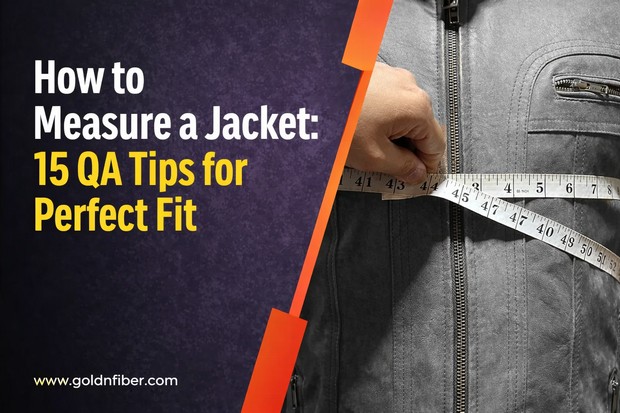
Basic Points to Measure a Jacket or Top Garments
Now we will elaborate those point’s which are usually followed in the ready made garment industry. HPS means high point shoulder, CF means center front, and CB means center back, which are the common reference points used in measurement sheets.
- Body Length (Front)
- Body Length (Back)
- Arm Hole
- Chest
- Bottom
- Zipper Length
- Across Chest (Front)
- Waist
- Bicep
- Sleeve Opening
- Shoulder Width
- Across Chest (Back)
- Sleeve Length
- Top Collar Length
- Neck Circumference
Detailed Jacket Measurement Procedure
Let’s see these significant factors in the following articles: Before measuring, close the zipper or placket in the buyer-approved position and smooth the seam line without stretching the fabric. If the style sheet gives a tolerance, keep it beside you while measuring so the pass or fail decision is immediate.
1) Front Body
First lay the top garment on a QA table horizontally. Then measure straight through measuring tape from high point shoulder (HPS) to bottom of front body. Make sure the garment is fully relaxed and not twisted before you start measuring.
2) Back Body
Measure straight through measuring tape from high point shoulder (HPS) to bottom of back body.
3) Arm Hole Curve
Measure along curve seam from top of the shoulder to underarm point.
4) Chest
Measure straight through measuring tape across the body at 1″ below from armhole point.
5) Bottom
Measure straight through measuring tape across body below at 2″ above from bottom line.
6) Zipper Length
Measure from top zipper stopper to bottom zipper stopper.
7) Across Chest Front
Measure straight through measuring tape across front body at 7″ below from high point shoulder (HPS).
8) Waist
Measure straight through measuring tape across body at 21″ below from high point shoulder (HPS).
9) Bicep
Measure 1″ below through measuring tape from bottom of the armhole point then drag from underarm straight across to center fold of the sleeve.
10) Sleeve Opening
Measure straight through measuring tape from top of the sleeve cuff to the bottom of the sleeve cuff point.
11) Shoulder Width
Measure straight through measuring tape across from shoulder point to shoulder point at seam line of back body.
12) Across Chest Back
Measure straight through measuring tape across back body at 7″ below from high point shoulder (HPS).
13) Sleeve Length
Measure from center back neck (CBN) straight to armhole seam then turn it to edge of the cuff through measuring tape.
14) Top Collar Length
Measure from center front (CF) top collar point to center back (CB) top edge of the collar along with the top line.
15) Neck Circumference
Tie the neckline and put down on a QA table horizontally. Then measure along neckline or edge of neck seam by following curve line through measuring tape from center front to center back. If the style has a zipper or placket, keep it in the buyer-approved closed position before taking this measurement.
Accurate jacket measurement depends on the same point marking, the same laying condition, and the same buyer tolerance every time. If those three stay consistent, measurement disputes drop quickly.
Frequently Asked Questions (FAQs)
Q1. How do you measure a jacket correctly?
Ans: Lay the jacket flat, remove twists or wrinkles, and follow the buyer’s measurement sheet point by point. Check the spec sheet before starting because front body, chest, and sleeve points can differ by style.
Q2. What does HPS mean in garment measurement?
Ans: HPS means high point shoulder, the highest shoulder point near the neck. It is used as a starting reference for body length and sleeve measurements.
Q3. How do you avoid jacket measurement mistakes in QA?
Ans: Use one flat table, one tape, and one measurement method for all garments. Record the buyer’s tolerance beside the reading so you can judge pass or fail correctly.
Q4. What is the difference between body length front and back?
Ans: Front body length is measured from HPS to the front hem, while back body length is measured from HPS to the back hem. The two can differ if the style has shaping or a dropped back.
Q5. Should jacket measurements be taken with zipper open or closed?
Ans: Follow the buyer’s tech pack or approved sample. If the style is meant to be measured closed, keep the zipper or placket in that position before taking the reading.