Last Updated on June 16, 2026
Many of us wish to know, “how to calculate a basic T-shirt consumption”. Today I will share the formula with you for easy understanding. The T-shirt what we usually wear but we do not know how to find out its consumption. Besides this when we will get a job in the garment industry then we have to do core of T-shirt consumption frequently. It is a common task of a garment merchandiser to find out consumption as well as to prepare cost sheet. It is an important task of any garments industry to find out the accurate consumption of a product. Profit margin of any product mostly depends upon to find out accurate fabric and accessories consumption. If we can’t calculate exact consumption then we have to face fabric shortage problem during production or huge leftover problem after production closing. Fabric shortage problem in production or leftover problem after production closing both is harmful in garment industry.
In practice, the best calculation starts from the approved pattern, because body measurement alone will not cover seam allowance, shrinkage, and cutting loss.
Method of Fabric Consumption Calculation of a Knitted T-Shirt:
Before going to the consumption calculation, you have to identify the major parts of a knitted T-shirt. A knitted T-shirt consists of the following parts which have to count during consumption making-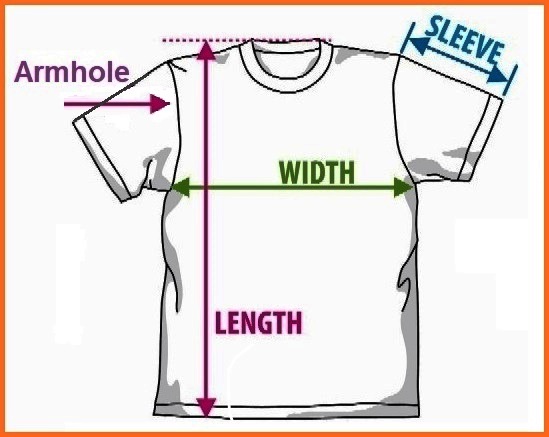
- Body parts (Front + Back)
- Sleeve (Left + Right)
- Armhole (Left + Right)
For a basic single jersey T-shirt, the collar rib or neck binding should also be added separately if it is part of the style.
Fabric: Jersey Knit
Item: Basic men’s s/slv T-shirt
Size: L
Fabric weight = 160 GSM
Suppose, Nike buyer has given an order of 20,000 pieces 100% cotton single jersey fabric T-shirt on a particular style which contains 160 gm GSM. Merchandiser has to find out accurate consumption before yarn and fabric booking. Buyer will provide a size measurement chart. Now he has to find out consumption based on the middle size of that measurement chart. We can select L size to get the consumption.
That is the correct starting point for a sample calculation, but the final booking should still be checked against the full size ratio if the order contains multiple sizes.
Please find the following measurement chart to go ahead
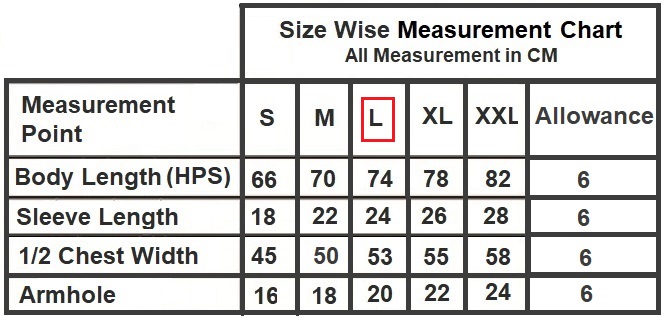
T-shirt consumption and cost sheet usually prepare on the basis of dozen. Formula will be same whether it is one piece or one dozen. There is two formula exists to prepare a basic T-shirt consumption. European buyer always prefers CM to do measurement but USA buyer prefers inch to do measurement of garments product. You should know both formulas to become an expert merchandiser. Let’s find first formula to prepare a basic T-shirt consumption.
Calculation – 01: Formula in Centimeter:
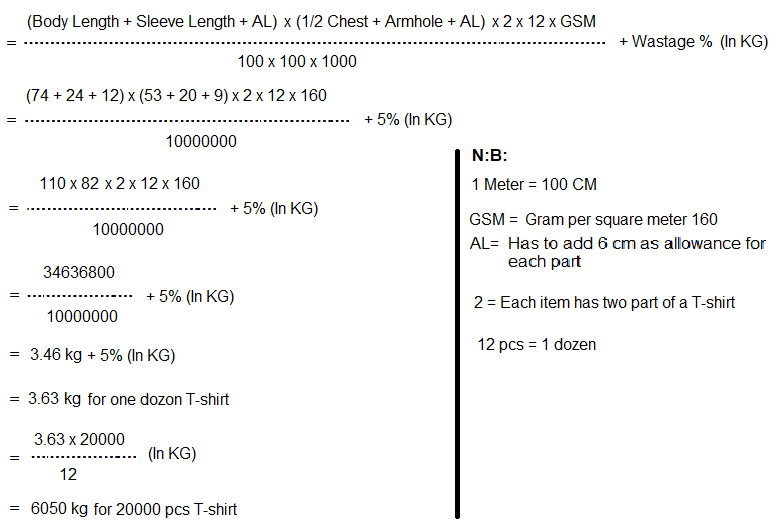
Based on the above formula we can realize that to make 20,000 PC T-shirts we need to book about 6050kg yarn.
Now we will know 2nd formula to prepare a basic T-shirt consumption.
Calculation – 02: Formula in Inch:
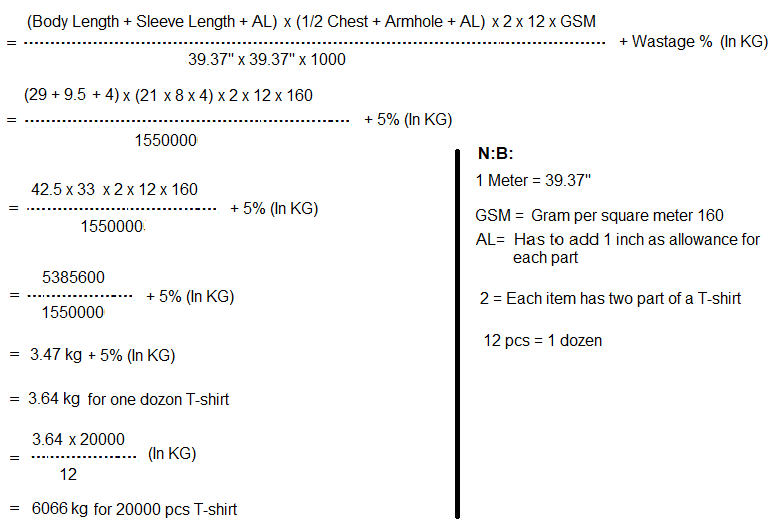 Based on the above formula we can realize that to make 20,000 PC T-shirts we need to book about 6000kg yarn.
N:B:
- 2 Means each item has two part of a T-shirt
- 12 PC = 1 dozen
- 100 = All measurement are in cm. 100 cm makes 1 meter
- 1000 = As we convert it to KG. Thus 1000 has inputted as a unit
In the actual cost sheet, the two main body parts are front and back, while sleeves, collar rib, and trims should be counted separately if the style uses them. In actual production, fabric width also matters because two fabrics with the same GSM may not give the same consumption if the usable width is different. In the actual cost sheet, add sewing thread, labels, trims, and packing accessories separately if they are not already included in the fabric calculation.
Accurate T-shirt consumption comes from the approved pattern, not guesswork. Once you account for fabric width, shrinkage, and marker waste, your booking becomes closer to reality and production shortages drop sharply.
Frequently Asked Questions (FAQs)
Q1. How do you calculate T-shirt consumption per piece?
Ans: Use the approved pattern, fabric width, GSM, and allowances for seam and shrinkage. Then convert the garment area into fabric weight and round up for marker waste.
Q2. How much fabric is needed for one basic T-shirt?
Ans: It depends on size, fabric width, and design details, so there is no single fixed answer. A basic single jersey T-shirt should be booked from the marker, not from body measurement alone.
Q3. What is the formula for T-shirt fabric consumption in kg?
Ans: The practical method is to calculate the fabric area of all garment parts, multiply by GSM, and divide by 1,000,000 to convert square centimeters to kilograms. Then add allowance for shrinkage and cutting loss.
Q4. Why does T-shirt consumption change by size?
Ans: Larger sizes use more fabric because the body width, sleeve length, and total pattern area increase. That is why merchandisers usually calculate from the middle size and then adjust for the full size set.
Q5. What is the difference between fabric consumption and marker consumption?
Ans: Fabric consumption is the estimated fabric needed for one garment, while marker consumption reflects how efficiently pattern pieces are placed on the fabric. Marker efficiency can make the final booking higher or lower than the basic pattern calculation.