Last Updated on June 11, 2026
What Is Merchandising in the Garment Industry?
A merchandiser is known as a key person who is commonly concerned in business promotion by buying and selling of goods. The merchandiser usually works with all departments in a company; management, design, procuring, and production, sales and promoting to confirm the finished product is executed correctly and on time. Merchandising is a process which helps to arbitrate production and marketing sections. It is a complicated procedure of practices and actions used to encourage and uphold certain types of commercial activity. The individuals who engaged in this sector are known as a merchandiser. A merchandiser has to perform as a communicator between buyer and seller. He starts the conversation with the buyer or his agent and creates a friendly environment between both parties. Usually, merchandiser works with the design team to display the product or promote product line efficiently. In a factory setting, this usually means the merchandiser sits between the buyer, sourcing, sampling, production, and shipping teams, and one missed update can affect all of them.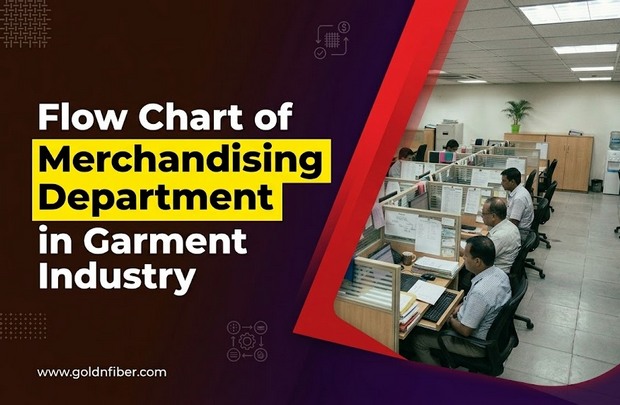
Why Merchandising Matters in Apparel Business
A merchandiser is a key person in any production house if we evaluate his entire job routine. They have to know many terms and definitions to continue his assign job smoothly. They should have strong negotiation and communication skills with visual and analytic capabilities. He or she should follow 4 R’s (Right Quantity, Right Quality, Right Cost & Right Time) strictly if they wish to execute their assign job perfectly. Merchandising actions may indicate display techniques, pricing, free samples, market analysis, shelf talkers, on spot demonstration, special offers, consumers feedback and other point-of-sale methods. If you have worked on an export floor, you already know the 4 R’s are not theory. They are the daily test of whether an order can ship profitably and on time. In practice, that also means checking sample comments, fabric availability, and delivery dates before the buyer asks twice.
Who Is a Merchandiser?
Theoretically, a merchandiser is a person who plans, develops and presents a product to a target market. In reality, he is a person designated to coordinate between the customer and manufacturer to ensure product quality and specified shipment time. In the context of the situation, a merchandiser is an individual who sources customer, negotiates with him, secures an order, sources materials, follows up production, shipment & makes regular contact with the buyer during the whole period from obtaining order up to the delivery of the consignment.
In many knitwear factories, the merchandiser also chases lab dips, trims, and approvals, because waiting for another department to notice a delay is how orders slip.
Importance of Merchandising
Morris Hite was a prominent American author, advertising consultant and self-educated person said
“Advertising moves people toward goods; merchandising moves goods toward people.”
– Morris Hite
Why Merchandising Moves Goods Toward Customers
He illustrated the following line to comprehend the significance of the above statement. Merchandising strategy boosts up products sales, clear product’s rack and makes you ahead to reach your targets than your competitors.
A merchandiser who understands costing, lead time, and buyer behavior can save a factory more money than one late corrective action ever can.
The word merchandising has become very popular in young generation. And the job of merchandisers has also taken a very popular dimension in this country. The concept of marketing & merchandising has somewhat emerged from the cover of the phrase merchandising. Marketing refers to promotion, delivery & sales of a product to the customer while merchandising means planning, development &” presentation of merchandise (product or product line) for a target market in respect of prices, assortment, timing, styling, etc. Merchandising department is the pivotal center for coordinating the development of merchandise, its design, realization of design, and up to the delivery of the merchandise to the customer.
In many factories, merchandising is the department that notices problems first. If the buyer changes fit, fabric, or packing after approval, the merchandiser is the one who must translate that change into time and cost.
Challenges in the Merchandising Department
Quick Response, Buyer Pressure, and Market Change
The job of merchandisers has, of late, become very challenging and complicated due to a number of reasons:
- Frequent fashion change
- Growing complexity of line and product development
- Complex channels of distribution and sales
- Increasing emphasis on Quick Response relationship between buyer-vendor-customer etc.
Among these, quick response is often the most underestimated. Buyers may forgive a small issue, but they rarely forgive slow communication.
Under the business circumstances of the local company, merchandisers are increasingly engaged in sourcing and securing orders, preparing a material list, sourcing suppliers & their materials, etc. In smaller factories, one merchandiser may handle sourcing, sampling, production follow-up, and shipment coordination together, so record keeping becomes as important as negotiation. A common mistake seen in many units is treating sample approval as the end of merchandising. It is not. If the buyer changes a color, size ratio, or packing instruction later, the merchandiser must recalculate the impact immediately.
Flow Chart of Merchandising Department in Garment Industry

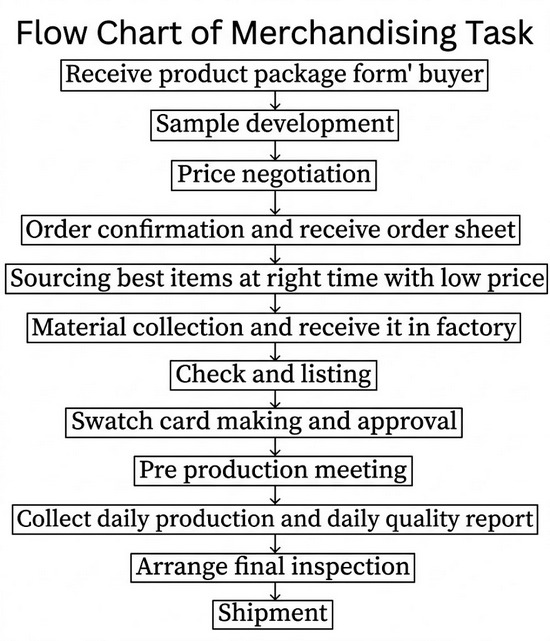
The work of merchandising may be the following:
Fashion Trend Study and Buyer Research
- Study of fashion trend & fashion forecasts in association with fashion designer
- Considering potential target customer
- Sourcing information about the customer and his profile (type of customer)
- Sourcing information about a product, its categories, styles, specifications, assortments, size details, etc.
- Sourcing foreign buyers
Order Negotiation, Costing, and Pricing
- Negotiating orders, cost calculation, pricing, securing orders through master LC
- Sourcing fabrics, trims & accessories
- Placing order for the above materials & making regular follow-up
- Getting samples made, making costing & pricing of the same
- Rectifying samples if necessary
Sampling, Approval, and Order Confirmation
- Completing the whole sampling procedure as per customer requirement
- Getting buyer’s approval of the sample
Production Follow-Up and Shipment Coordination
- Estimating lead time
- Production & shipment planning
- Keeping track of raw-material arrival, production cycle, and organizing inspections
- Monitoring production & product quality
- Making regular liaison with the customer and keeping him updated on order & production status
- Follow-up client instructions in respect of packing & packaging
- Arranging product delivery on time.
- Follow up customer direction in respect of shipment and inform him shipment details
- He has to coordinate with shipping/export departments
- Arranging payment against export order.
- Quick response follow-up in respect of the buyer’s query.
What happens if fabric arrives on time but a trim is short? The order still stops. That is why the merchandiser must monitor every critical path item, not just the fabric booking. A merchandiser is successful when the order moves smoothly, the buyer stays informed, and every department works from the same sheet. That is the real job, not just sending emails.
Merchandisers must coordinate & follow-up with each and every development & monitor all the processes in product realization. It is the Job of the merchandisers to update information with the customer about all aspects and status of the order. Customers must be informed only to day basis about the progress of the concerned order, and all queries must be responded on an emergency basis. Merchandisers cannot and must not keep the customer waiting.
Frequently Asked Questions (FAQs)
Q1. What is the role of a merchandiser in the garment industry?
Ans: A merchandiser coordinates between the buyer and the factory, follows up sampling, sourcing, production, and shipment, and keeps all departments aligned. If communication is weak, delays usually start here.
Q2. What are the main responsibilities of a merchandiser in apparel export?
Ans: The main responsibilities include order negotiation, costing, material follow-up, sample approval, production tracking, and shipment coordination. A good merchandiser also keeps the buyer updated before problems become delays.
Q3. What skills does a garment merchandiser need?
Ans: A merchandiser needs strong communication, negotiation, costing, and follow-up skills. Basic knowledge of fabric, trims, production flow, and buyer requirements is also essential.
Q4. What is the difference between merchandising and marketing in garments?
Ans: Marketing focuses more on promotion and sales, while merchandising focuses on planning, development, sourcing, and execution of the product order. In garment factories, merchandising is the bridge between the buyer’s requirement and production reality.
Q5. Why is follow-up important in merchandising?
Ans: Because most order problems start with a missed approval, delayed material, or unclear communication. Regular follow-up helps the merchandiser protect the delivery date and control the order smoothly.