Last Updated on June 11, 2026
Anyone who has worked in a garment factory, fabric warehouse, or merchandising office has faced this question at some point: “How many kilograms are there in one yard of fabric?”
A yard is fixed length, but cloth weight comes from area, so GSM and usable width decide the kilogram value.
The interesting part is that there is no single answer. That is why merchandisers keep a yard-to-kg conversion sheet ready during costing and fabric booking.
A common situation occurs during fabric sourcing. A buyer may place an order in yards, while the mill supplies fabric in kilograms. The merchandising team then needs to convert one unit into another to estimate fabric consumption, calculate costing, and prepare production plans. Novice textile professionals often expect a fixed conversion factor, but fabric does not work that way. This is especially important when the buyer order comes in yards but the mill invoice is raised in kilograms.
The weight of one yard of cloth depends on several factors, including fabric construction, GSM, width, fiber type, and fabric structure. A yard of lightweight voile fabric and a yard of heavy denim fabric can differ dramatically in weight.
Understanding this conversion correctly is essential for textile students, merchandisers, production managers, and sourcing professionals.
Formula to Convert 1 Yard of Cloth into Kg
How many yards are there in 1 kg of cloth or how many kg is equal to 1 yard of cloth can be easily calculated with the help of the following formula. Fabric measuring formula yards to kg is very important to produce knit garments. In the context of knit garment merchandising you have to know this converting formula to accomplish yarn booking to do fabric manufacturing. For this we need to know the weight per square meter (GSM) and width of the fabric:
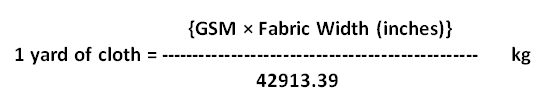
Example: 1 Yard of 165 GSM Fabric with 58 Inch Width
For example:
1 yard of cloth of 165 gsm and 58 inch width is equal to how many kg –
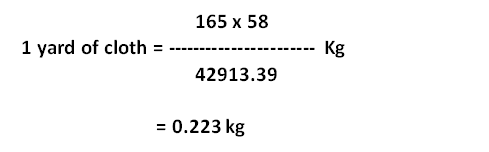
Explanation:
GSM 165 for clothes means-
165 grams of cloth = 1 square meter
This method uses area, not length alone, which is why width changes the result even when GSM stays the same.
So,
1000 grams (1 kg) of cloth = 1000÷165
= 6.06 m square
Area = Length x Width
Here length of cloth = 1 yard
Width of cloth = 58 inches
(1 yard = 0.9144 meter)
(58 inches = 1.473 meters)
Area of cloth = 0.9144 x 1.473 square meters
= 1.347 m square
So, 6.06 meter square cloth = 1 kg
So 1.347 meter square fabric = 1.347 ÷ 6.06 kg
= 0.222 kg
This worked example assumes the 58-inch width is the usable fabric width. If your width is different, the answer will change.
Practical Note for Merchandisers
Please be noted that this formula is very convenient to find out fabric quantity from kg to yard. Thus, this formula is frequently used in knit garment industry to give prior yarn booking to accomplish fabric manufacturing.
So the safest rule is simple: check GSM, usable width, and unit conversion before you convert yards into kilograms. That small step prevents costly booking errors.
Frequently Asked Questions (FAQs)
Q1. How do you convert yards to kg of fabric?
Ans: Use the formula kg = (GSM x width in meters x length in meters) ÷ 1000. For 1 yard, the length is 0.9144 meter. This gives a practical weight estimate when GSM and usable width are known.
Q2. Does fabric width affect kg per yard?
Ans: Yes, directly. A wider fabric has more area in one yard, so it weighs more even if the GSM stays the same.
Q3. How many kg is 1 yard of 165 GSM fabric?
Ans: It depends on the fabric width. In the article’s 58-inch example, 1 yard works out to about 0.222 kg, but a different width will give a different result.
Q4. What is the reverse formula from kg to yards of fabric?
Ans: You can estimate yards by dividing 1000 by GSM x width in meters x 0.9144. This is useful when the mill quotes kilograms but you need yardage for booking or planning.
Q5. Is GSM enough to calculate fabric weight accurately?
Ans: No. GSM tells you the weight per square meter, but you also need fabric width and length to convert it into kilograms or yards. Without width, the calculation will not be accurate enough for merchandising.