Last Updated on June 11, 2026
A merchandising team closes a basic T-shirt order, the body fabric looks safe, the print is confirmed, and then the collar starts creating trouble. If the neck rib is under-calculated by even a small amount, the factory feels it in cutting room shortages, sewing line delays, and a messy last-minute fabric purchase. If you have worked on a production floor, you already know this: the “small” collar component can quietly damage both cost and delivery.
That is why learning how to calculate neck rib consumption of a basic T-shirt matters so much. Merchandisers usually want it in grams per piece, while pattern teams often think in cut length. You need both views. And if the rib is not stable in wash, the neat formula on paper becomes meaningless.
Why Neck Rib Consumption is Often Underestimated
The neck rib is not just a strip of fabric around the neckline. It carries tension, recovery, and appearance. It also sits at the most visible part of the garment. A common mistake I saw in a Gazipur unit was this: the team used the finished neckline measurement, applied a fixed deduction, and ignored compacting shrinkage from the rib mill. The sample looked fine. Bulk production did not.
In practice, using one “standard” deduction for every style is lazy. A 5 percent reduction may work for one 1×1 rib quality, while another lot may need 8 or 10 percent to sit flat. If you force the wrong ratio, the collar either waves or chokes. Which problem do you want on a buyer inspection?
How to Calculate Neck Rib Consumption of a Basic T-shirt
Start with the neckline measurement from the approved pattern or garment spec. Then decide the rib reduction. For a basic crew neck T-shirt, reduction usually sits around 5 to 10 percent, depending on rib recovery, garment size, and how tightly the neckline must hold.
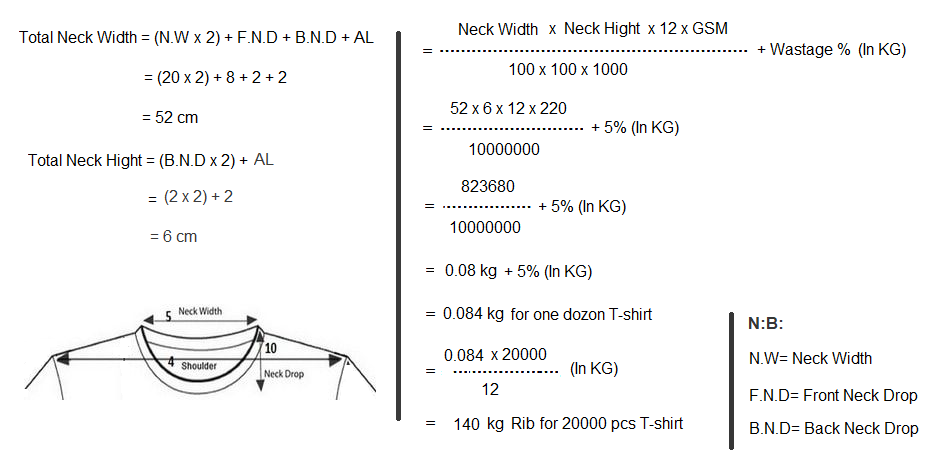
Neck rib item of T-shirt is different from main body. Buyer will provide neck rib GSM. 200-220 GSM 100% cotton 1×1 single jersey fabric usually used for neck rib. Now we will learn how to calculate neck rib consumption of a basic T-shirt. We need following item measurement to find out rib consumption:
- Neck Width (N.W) = 20 CM
- Front neck drop (F.N.D) = 8 CM
- Back neck drop (B.N.D) = 2 CM
There are two formula exist to find out neck rib. Let’s find out 1st formula to pick neck rib consumption of a T-shirt.
Calculation – 01: Formula in Centimeter
Calculation – 02: Formula in Inch
Now let’s find 2nd formula to get neck rib consumption of a T-shirt. 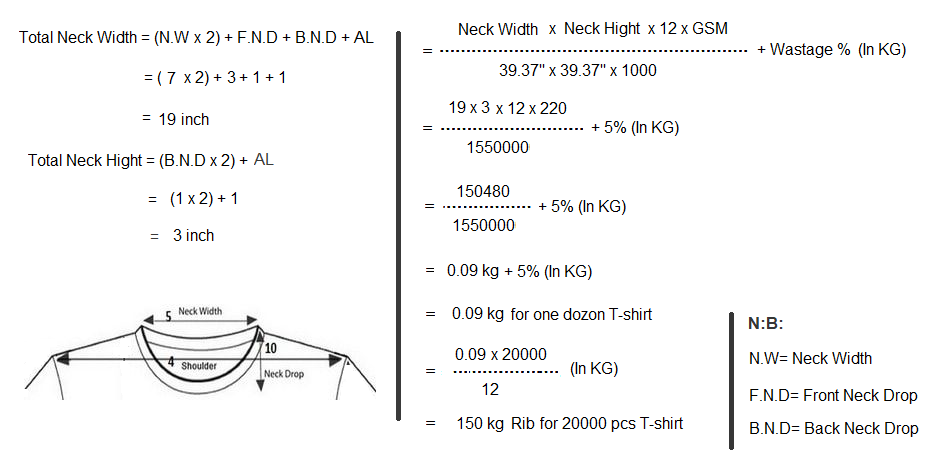
Conclusion
If you want fewer surprises in bulk, stop treating neck rib as a minor accessory. It is a measurable, costed, quality-critical component. The real industry challenge now is not just learning how to calculate neck rib consumption of a basic T-shirt, but building a calculation method that includes shrinkage, recovery, and real mill variation before the first marker is laid.
Frequently Asked Questions (FAQs)
Q1. How do you calculate neck rib consumption of a basic T-shirt?
Measure the neckline opening, apply the rib reduction ratio, add seam allowance, and then convert the cut length and cut width into weight using rib GSM. A common formula is: cut length x cut width x GSM ÷ 10,000 = grams per piece.
Q2. What reduction ratio is used for neck rib in T-shirt production?
For a basic T-shirt, the neck rib reduction ratio is usually 5% to 10%, depending on the rib quality, recovery power, neckline shape, and garment fit requirement.
Q3. How does rib GSM affect neck rib consumption in garments?
Rib GSM directly affects consumption. If the cut length and cut width stay the same, a higher GSM rib will increase the consumption in grams per piece.