What Are Smart Textiles?
When a textile performs an additional function in addition to its conventional purpose, it earns the label of a “smart textile.” If the additional functionality of the textile changes with variations in usage conditions, it qualifies as an “active smart” or “intelligent textile.” Conventional textiles cover the human body and provide a protective barrier against dust, sunlight, wind, and other contaminants in the normal living environment. They also perform technical functions that make use of their robust and adaptable structure. Textiles may perform additional functions specific to unfavorable or extreme climates, job environments, or professions, enhancing the user’s adaptability and productivity. In apparel, the most common smart-textile formats are coated yarns, laminated fabrics, and microencapsulated finishes, because they keep the fabric flexible while adding the extra function.
How Smart Textiles Work
The following figure illustrates how smart textiles work and helps in understanding their operational functionality: In practice, these functions are usually built into the fabric through coatings, embedding, or conductive yarns rather than by changing the textile base itself.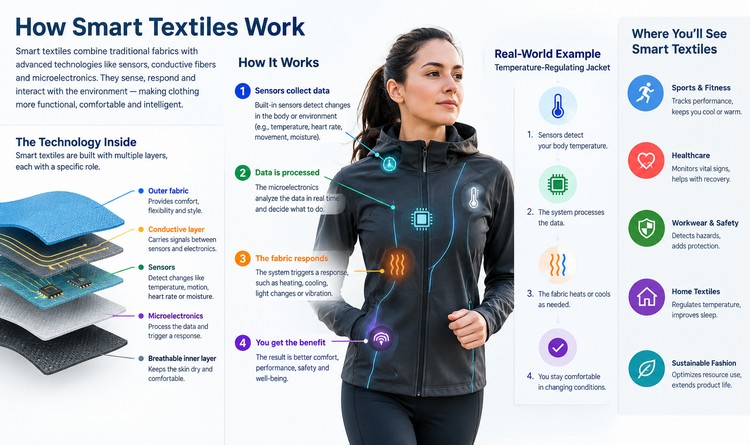
Types of Smart Textiles
Smart textiles, or responsive textiles, can be broadly classified based on the active responses they exhibit. A single product can show more than one response, so the main classification usually depends on the dominant function in use.
- Shape alteration: Smart textiles can undergo shape alteration, either reversible or unidirectional, by increasing or decreasing their dimensions and bending.
- Storage and release: Smart textiles have the capacity to store and release heat, drugs, chemicals etc.
- Electronic functionality: Smart textiles may also possess electronic functionality for communication, entertainment, and monitoring purposes.
Shape-Changing Smart Textiles
Researchers developed shape-changing fibers, yarns, and fabrics using stimuli-sensitive polymers (SSPs). These amazing polymers undergo a reversible transformation from one state to another in response to numerous environmental stimuli. The scientific community refers to these amazing materials as smart polymers or intelligent polymers. In textile design, thickness, crosslink density, and how the active phase is anchored to the fiber often decide whether the material performs well after repeated bending and washing.
The linear SSPs change from soluble (clear) to insoluble (turbid) at the transition temperature. In the gel form, however, they swell and de-swell due to the absorption of water or discharge. This results from the existence of cross-links. In most applications, people utilize these materials in gel or cross-linked form. A slight change in the relevant stimulus can produce alterations in their configuration, dimension, or physical attributes.
Researchers extensively study temperature-sensitive polymers among the several stimuli-sensitive polymers. In addition to temperature, these polymers can undergo reversible transitions when exposed to chemical and physical stimuli such as
- Electric field.
- Light.
- Pressure.
- Solvent composition.
- Sound.
- Stress.
- Magnetic field.
- Chemical and bio-chemical stimuli (pH and ions).
These polymers offer numerous prospects for the development of intelligent materials. In real garments, response speed, fatigue resistance, and wash durability matter just as much as the trigger itself.
Applications of Smart Polymers
Various critical applications in biomedical and engineering fields benefit from smart or intelligent materials. They can respond to their environment by changing their shape or properties. These applications include
- Controlled drug delivery.
- Enzyme-activity control.
- Controlled drug separation processes.
- Vascular tissue culture.
- Artificial muscles and smart textiles.
Temperature-Sensitive Smart Textiles
Researchers create temperature-sensitive smart textiles by utilizing temperature-sensitive polymers (TSPs). These types of smart polymers undergo a transition referred to as Lower Critical Solution Temperature (LCST). These polymers possess both hydrophilic and hydrophobic groups within their structure.
| Polymer group | Polymer name / chemical repeat unit | LCST, °C |
|---|---|---|
| Poly (N-alkyl substituted acrylamides) | Poly(N-isopropylacrylamide) | 32 |
| Poly(N-n-propylacrylamide) | 16 to 19 | |
| Poly(N-isopropyl methacrylamide) | 40 | |
| Poly(N-cyclopropylacrylamide) | 4 to 6 | |
| Poly (N-vinyl alkylamides) | Poly(N-vinylcaprolactam) | 32 |
The structure of TSPs exhibits a delicate hydrophobic-hydrophilic equilibrium. Slight temperature variations around the critical temperature cause the chains to either collapse or expand. This results in response to the altered interactions between the hydrophobic and hydrophilic components of the polymeric chains and the aqueous medium. The most extensively researched thermo-sensitive polymer is poly-N-isopropyl acrylamide (PNIPAm). It features a hydrophobic backbone with a pendant group comprising a hydrophilic amide moiety and a hydrophobic isopropyl moiety. For clothing, the practical aim is to place that transition close to the wearer’s comfort range, not simply to maximize the polymer response in isolation.
When the temperature remains below the Lower Critical Solution Temperature (LCST), hydrophilic interactions take dominance. These interactions involve hydrogen bonds forming between water molecules and the N-H or C=O groups of PNIPAm. These reactions cause the polymer to be soluble in water. However, when the temperature surpasses the LCST, hydrophobic interactions become dominant, leading the polymer to become insoluble in water. It is possible to adjust the transition temperature of these TSPs. One can
- Alter the ratio of hydrophilic and hydrophobic groups.
- Incorporate additives.
- Adjust the nature of the polymer system.
These thermo-sensitive monomers make polymer gels do the following:
- In water below the transition temperature, change shape through swelling.
- Deswell above the transition temperature.
Shape-Changing Smart Fabrics
Researchers produce shape-changing model fabric by coating cotton yarns with a temperature-responsive polymer and subsequently cross-linking them. In the case of coatings, poly carboxylic acid generates the cross-links, forming covalent bonds between the copolymer’s amide side-groups and the hydroxyl group of the cellulosic substrate. In comparison to polymer-gel discs, the table below illustrates the transition properties and response time of TSP in various processed forms.
| Type | Thickness | Swelling (change in shape %) | Time for 70% of equilibrium swelling | Time for complete deswelling |
|---|---|---|---|---|
| Gel disc (conventional) | 2 mm | 490 | 90 min | 50 min |
| Coated on Yarn | 39 µm | 4500 | 3 min | 10 sec |
| Fiber | 30 µm | 17800 | <5 sec | <1 sec |
Table: Comparison of transition properties of TSPs in different processed forms.
These response-time values are laboratory comparisons, so the exact numbers vary with formulation, coating add-on, and test medium.
The responsive coated yarn demonstrates an astonishingly high degree of swelling and deswelling across the transition temperature. It achieves 70% of equilibrium swelling in just 3 minutes timeframe, while gels take 90 minutes for the same degree of swelling.
The following figure(a) illustrates the optical photographs of the model fabric at different temperatures. The yarns indicate high swelling at temperatures below the transition temperature, but beyond the transition temperature, the yarns deswell, liberating all the water. In a water bath, the model fabric’s percentage cover ranges from 0% at 6 °C to 39% at 30 °C and 57% at 80 °C. For a number of cycles, this transformation is totally reversible. The optical microphotographs in figure(b) clearly show how porosity (% cover) changes with temperature.
This is one reason fiber-scale systems are favored in wearable design, because they combine faster response with better drape than bulk gels.
Shape-Changing Smart Fibers
The researchers also successfully transformed the TSP into a fine diameter, shape-changing textile fiber. The optical micrographs, which show a 178% change in volume in Figure, illustrate how the fiber goes through changes in both diameter and length with temperature variation.
The time requirement for a 70% transition (swelling) decreased considerably from 90 minutes for the 2 mm gel disc to less than 5 seconds for the TSP fiber. Furthermore, the change in shape (swelling ratio) of the fibers increased by 36 times.
pH-Responsive Smart Polymers
pH responsive smart hydrogels are polymers that can sense the pH of their environment as a signal, estimate the strength of the signal, and alter their properties accordingly. According to the researchers, the crucial component of the system is the existence of ionizable weak acidic or basic moieties attached to a hydrophobic backbone. The functional groups consist of ionizable acidic pendant groups. For example, carboxylic and sulfonic acids, or basic groups like amines that can accept and donate protons in response to changes in environmental pH. As the surrounding pH shifts, the degree of ionization in pendant groups undergoes a significant change at a specific pH known as pKa. The net charge of pendant groups quickly changes, altering the hydrodynamic volume of the polymer chains. A collapsed hydrophobic state to a soluble hydrophilic state transition occurs as a result of the polymer.
For apparel and skin-contact products, pH response is attractive for sensing sweat chemistry, but it is harder to keep stable through washing than thermal PCM systems.
pH-Responsive Smart Textiles
The table below shows some approaches based on co-monomers consisting of acidic carboxylic acid groups or basic amino groups. The hydrogel’s ability to swell and contract depends on a number of variables, including its
- Hydrophobic-hydrophilic behavior.
- Crosslink density (elasticity).
- Charge density.
- pKa.
| Monomer | Responsive group | Typical response |
|---|---|---|
| Acrylic acid and its derivatives | -COOH | Swells in alkaline pH |
| Vinyl monomers with sulphonic acid | -SO3H | pH-sensitive swelling, often stronger in alkaline conditions |
| N-vinyl pyrrolidone | Hydrophilic comonomer | Tunes water uptake and swelling |
| NH2 or substituted amino | Amino group | Swells in acidic pH |
| N,N-diethyl amino ethyl methacrylate | Tertiary amino group | Swells in acidic pH |
Table: Commonly used synthetic monomers and polymers for pH sensitive hydrogel
Hydrogels are a desirable replacement for artificial muscles. However, the excessive water content is the cause of their poor mechanical qualities. In contrast, polymeric fibers have superior mechanical properties as a result of their high degree of crystallinity and orientation. Therefore, thin fiber forms with improved transitional qualities are preferred for usage in artificial muscles, sensors, and actuators. That is why researchers often move from bulk gels to fibers or coatings when they want a wearable product rather than a lab sample.
Thermo-Responsive Smart Textiles
A thermo-responsive textile can also qualify as an environmentally responsive textile. The term “thermo-responsive textile” refers to clothing that actively helps to regulate body temperature, with about 33 °C to 34 °C, according to recent thermophysiology literature, being the ideal mean skin temperature for humans. In practice, this is a mean skin-temperature reference, not a fixed value for every body site. The human body independently controls its body temperature. To control the release of heat, the human body utilizes various mechanisms, including
- Blood vessel dilation.
- Blood vessel constriction.
- Muscle activity.
- Sweat gland function.
According to the external temperature, individuals should put on or take off garments to keep their skin temperature between roughly 30 °C and 36 °C, a range often used in recent thermophysiology literature as a practical comfort band. This band shifts with activity level, humidity, clothing insulation, and the body site being measured, so it should be read as a practical reference rather than a fixed physiological limit. However, if clothing had the capability to independently modify its thermal resistance in response to temperature, it would be able to manage the rate of heat release and control the body’s core temperature. The use of Phase Change Materials (PCMs) can boost thermal comfort. PCMs are specific materials that go through phase changes from solid to liquid. First they absorb heat, then they release heat as they return from liquid to solid.
The materials must exist as liquids in one of the transition states. For that, researchers need to encapsulate them to prevent them from leaking out of the clothing during a phase change. A practical PCM textile usually chooses its phase-change point near the expected wearing temperature, because a mismatch of even a few degrees can make the finish feel inactive in use.
Phase Change Materials in Smart Textiles
Phase Change Materials (PCMs) are substances used to store and release thermal energy during phase transitions. They are required to exist in liquid form during specific transition states. To prevent any leakage from the clothing during these phase changes, it is essential to encapsulate the PCMs securely. In finished textiles, the real test is not only latent heat storage but also whether the encapsulated material survives bending, abrasion, and repeated washing.
How PCMs Work
The mechanism of Phase Change Materials (PCM) involves their ability to store and release thermal energy during phase transitions. When exposed to heat, PCM absorbs energy and changes from solid to liquid form, storing the latent heat. Conversely, when the surrounding temperature decreases, PCM releases the stored energy as it changes back from liquid to solid state. This property allows PCMs to act as effective thermal energy storage mediums, helping to regulate temperatures in various applications, such as building insulation, textiles, and electronics cooling. The reversible phase change process enables PCMs to repeatedly absorb and release energy, making them valuable for efficient thermal management systems.
Textile developers commonly verify this with differential scanning calorimetry for latent heat and fabric-level tests such as the guarded hotplate methods in ISO 11092 or ASTM F1868, because a good lab result does not always mean a durable garment finish.
Applications of PCMs in Clothing
These materials can provide benefits and find applications in various situations, such as the following:
- Encapsulated Phase Change Materials (PCM) in clothing can produce a constant temperature buffer, enhancing wearer comfort. The PCM incorporated within the fabric absorbs excess body heat when the surrounding ambient temperature rises, preventing the wearer from feeling too hot. In contrast, the PCM releases the heated energy as the surrounding air becomes cooler to keep the wearer warm. This dynamic temperature regulation helps maintain a stable and comfortable experience for individuals, regardless of external weather conditions. As a result, clothing with PCM technology can boost overall comfort and performance in various activities and environments.
- These include occupations that require the individual to deal with extreme changes in the surrounding environment. For example:
- Pilot’s uniform in a fighter plane.
- Soldier’s uniform in extreme climate zones.
- Uniforms for workers operating in extreme temperatures.
- Firefighters’ gear.
- Tents and temporary structures designed for extreme climates.
- Automobiles with climate control features.
Microencapsulated PCMs
Microencapsulated Phase Change Materials (PCMs) refer to tiny particles of PCM materials that are encapsulated within a protective coating or shell. The microencapsulation process involves enclosing the PCM substance, which can be a solid-liquid phase-changing material, within microscopic capsules, usually made of polymers. This protective shell acts as a barrier, preventing the PCM from leaking or reacting with other components until it undergoes a phase change. Microencapsulation is what makes the finish workable in clothing, but shell selection still decides softness, leakage resistance, and wash life.
The microencapsulation technique enhances the properties and applicability of PCMs in various fields. It allows the PCM to remain stable and dispersed in a solid state at room temperature, and upon exposure to heat, it undergoes a phase transition from solid to liquid, storing thermal energy. Conversely, during cooling, the PCM releases the stored energy as it solidifies again. This controlled release of thermal energy makes microencapsulated PCMs highly valuable for applications such as:
- Smart textiles.
- Building materials.
- Thermal energy storage systems.
- Temperature regulation in various products and environments.
Microencapsulated PCMs must have the following key parameter:
- Particle size and consistency.
- A high core-to-shell ratio.
- Thermal and chemical stability.
- Mechanical stress tolerance.
If the shell is too brittle, the capsule fails early; if it is too soft, the PCM can migrate, so the balance has to be tuned to the end use.
Future of PCMs in Smart Textiles
The primary focus of early research on latent heat storage was on examining the dehydration and hydration properties of inorganic salt hydrates. Their exceptional properties, including high energy storage density and superior thermal conductivity, drew this attention. However, inorganic salt hydrates cause corrosion and are incompatible with a variety of materials. Moreover, they also exhibit supercooling and phase separation during thermal cycling transitions. To overcome some of the issues with inorganic PCMs, researchers have shifted their focus to studying the properties of various organic compounds and their mixes as potential novel PCMs. Today, the work is shifting toward lower-leakage shells, bio-based waxes, and finishes that stay effective after repeated laundering rather than only short laboratory trials.
They are also attempting to improve the heat capacity, thermal stability, thermal conductivity, and durability of composites that house PCMs. This research shift intends to overcome the limits of inorganic PCMs and investigate more efficient and practical alternatives for latent heat storage applications.
For clothing applications, researchers prefer using PCMs that undergo phase transition within a temperature range of 18 °C to 35 °C. Additionally, among the suitable options for textile applications, paraffin waxes, particularly n-eicosane, n-octadecane, and n-hexadecane, stand out as highly appreciated choices. This preference is primarily attributed to their high latent heat capacity and the temperature interval at which they undergo phase change. For apparel, this usually means coatings or microcapsules in outer layers, where the extra mass is easier to manage than in close-fitting base layers.
The thermal management in smart textiles is primarily governed by three main factors:
- The characteristics of PCMs.
- The composition of the shell that encapsulates them.
- The quantity of microcapsules integrated into the textile structure.
Conclusion
Smart textiles work best when the response is fast, durable, and comfortable in real use. For most apparel applications, coated yarns and microencapsulated PCMs remain the most practical options because they balance function with fabric feel and washability.
Frequently Asked Questions (FAQs)
Q1. What is a smart textile?
Ans: A smart textile is a fabric that can sense a stimulus and respond by changing one property such as temperature, shape, moisture handling, or conductivity. They are used in wearable tech, medical textiles, sportswear, and protective clothing.
Q2. What are some examples of smart textiles?
Ans: Examples include PCM jackets, conductive sportswear, pH-responsive wound dressings, and shape-changing fabrics used in medical or comfort applications. Many of these products combine textile comfort with sensing or thermal control.
Q3. How do smart textiles work?
Ans: Smart textiles work by using responsive polymers, microcapsules, sensors, or conductive yarns that react to heat, pressure, pH, light, or electricity. The fabric then changes a property such as shape, temperature behavior, or electrical output.
Q4. Are smart textiles washable?
Ans: Some smart textiles are washable, but not all. Wash durability depends on whether the active function is built into the fiber, yarn, coating, or capsule shell, and repeated laundering can reduce performance if the finish is not protected.
Q5. What is the difference between smart textiles and e-textiles?
Ans: Smart textiles respond to a stimulus, while e-textiles specifically include electronic components such as sensors, circuits, or power elements. Many modern products belong to both groups.