Introduction
In garment production, the choice of stitch can affect how a seam looks, how it performs, and how well it holds up in use. Production engineers need a clear numbering system to avoid confusion on the factory floor, and ASTM D6193 and ISO 4915 provide that structure. These standards help classify stitches by construction, while also supporting decisions for seam quality, buttonholes, bartacks, and other garment details. Ultimately, they are useful when different machines, fabrics, and construction methods must work together.
What Is a Stitch?
A stitch is a loop formation made by interlocking one or more threads by machine or hand to produce seams or surface decoration. Stitches may be concealed inside the garment or may show on the face of the fabric. Stitch types are referred to in terms that describe their configuration or effect.
What Is Stitching?
The process of forming a series of stitches is called stitching. In apparel manufacturing, stitching is carried out mostly by industrial machines, though hand stitching still has a place for decorative work.
Stitch Length and Thread Tension
Stitch length is measured in millimeters (mm) or can be designated by stitches per inch (SPI) or stitches per centimeter (SPC).
Thread tension is the relationship among the threads that form the stitches. When thread tension is balanced, the stitching has a smooth appearance, and the threads interlock in the middle of the fabric layers. If tension is not properly adjusted, unbalanced thread tension can appear on the face or inside of the stitch line as a bead or loop of thread between stitches. When stitch tension is too loose, seam grin occurs when stress is placed on the seam, causing the stitches to show at the seamline. When stitch tension is too tight, puckering appears along the stitch line, and the thread may break when tension is applied.
ASTM D6193 and ISO 4915 Stitch Standards
ASTM D6193, Standard Practice for Stitches and Seams, formerly Federal Standard 751a, and ISO 4915, Standard Practice for Determining Ticket Numbers for Sewing Threads, are used to classify stitches. These standards divide stitches into six classifications. The ASTM D6193 standard also includes an appendix covering sewn applications for buttons, snaps, hooks and eyes, buttonhole stitching, bartack reinforcement stitching, tacking, specialty stitching and seams, and a guide to count stitches per inch.
How Stitch Classes Are Numbered
Each stitch class is identified by the first digit of a three-digit number, ranging from 100 through 600. Individual stitches are identified by the second and third digits, which indicate their concatenation or series of thread configurations. In addition, each ISO stitch class number is accompanied by a name.
The 6 Main Stitch Classes
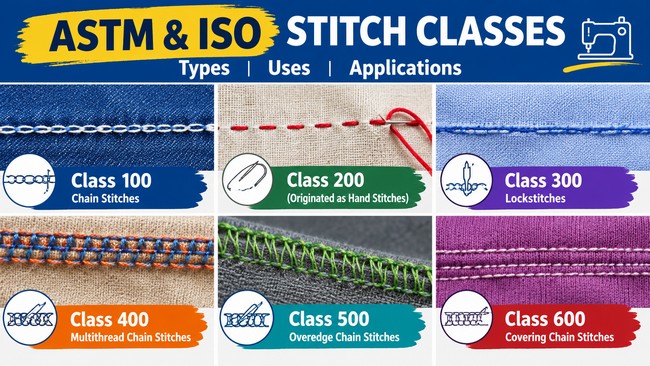
The six ASTM and ISO stitch classifications are as follows:
- Class 100 Chain Stitches
- Class 200 (Originated as Hand Stitches)
- Class 300 Lockstitches
- Class 400 Multithread Chain Stitches
- Class 500 Overedge Chain Stitches
- Class 600 Covering Chain Stitches
Factors That Affect Stitch Performance
Industrial sewing machines are usually designed to produce one type of stitch. Machines are fitted with numbered stitch size regulators that can be set to sew a selected number of stitches per centimeter or per inch, or stitch density. The set number is only an approximate indicator of stitches per centimeter or inch, so the setting is a starting point and must be tested for accuracy and performance.
Fabric Type and Weight
Stitch performance depends on fabric type and weight, as well as the number of plies being sewn. These fabric factors help determine the correct stitch for a given garment.
Thread Size and Tension
Thread size and thread tension also play an important role in stitch performance. Together, they affect the balance, strength, and appearance of the stitched seam.
Machine Type and Stitch Density
Machine type, stitches per centimeter or inch, and stitch density all influence how a stitch forms. Zigzag, buttonhole, and hem stitch machines, as well as special attachments that move the needle from side to side, produce stitch bite. Bite indicates the width of the track or stitching pattern. Blind stitch machines produce a variety of stitch configurations that hold garment plies together without visible stitching on the face of the garment.
Number of Fabric Plies
The number of plies being sewn must be considered along with the other factors listed. Overall, the type and size of machine stitches selected depend on garment design and style, garment use and function, garment care and life, fabric type and weight, placement of stitch, construction technique, method of production, and quantity of garments produced.
100 Class Chain Stitches
A 100 class stitch is a category of stitches in which a single thread passes through one ply or several plies of fabric and interloops with itself on the opposite surface. This loop formation produces a flexible stitch. Single-thread stitches can unravel if they are broken or cut, and they can be removed by pulling on an unlocked thread end. A sewing operator can regulate the stitch length.
Uses of Chain Stitches
Single-thread chain stitches are commonly used for:
- Blind hems of skirts, pants, jackets, and dresses
- Light construction
- Attaching trim
- Basting
- Stay chains to anchor linings or form belt carriers
Common 100 Class Stitches
The 100 class contains stitch types 101 through 105. The most commonly used stitches for apparel within this class are:
- 103 Blind stitch
- 104 Saddle stitch
200 Class Hand Stitches
The 200 class is a category of stitches created by hand or by machine to imitate handwork. One or more needle threads pass through one ply or several plies of fabric as a single line of thread that interloops on itself or is secured by passing in and out of the material so that it shows alternately on the face and reverse of the garment. Hand stitches are very labor-intensive and expensive, so their use is quite limited in mass-produced apparel. Machine-imitated hand stitches require special equipment. In mass production, hand stitches are more common for decorative purposes than for functional main seaming.
Uses of Hand and Simulated Hand Stitches
Simulated hand stitches are mainly used for decorative stitching that shows on the face of the garment.
Common 200 Class Stitches
The 200 class contains stitch types 201 through 205. The most commonly used stitches within this class are:
- 202 Backstitch or prick stitch
- 203 Decorative chain stitch
- 204 Catch stitch or herringbone stitch
- 205 Running stitch or saddle stitch
300 Class Lockstitches
The 300 class is a category of stitches in which single- or double-needle threads and the bobbin thread interlace midway between the surfaces of the fabric plies as they are fed through the machine, giving the same appearance on the top and bottom surfaces. Double needles may be spaced from 1/16 to 1/2 inch (1.6 to 12.7 mm) apart. Some in the industry consider lockstitches to be the standard or regular machine stitch. Stitch length can be regulated from 4 to 30 stitches per inch, depending on the machine.
Lockstitches can be formed in a straight line or in a zigzag pattern. Zigzag lockstitches are formed through the combined action of the needle moving from side to side and the fabric feeding through the machine, where the needle and bobbin threads interlace. A narrow bite is used for sewing seams, while a deep bite is used for finishing raw edges. Different industrial machines produce a wide variety of stitch patterns. Two stitches in the same direction and two stitches in the opposite direction form two-stitch zigzag stitches. Similarly, three-stitch zigzag stitches are formed by three stitches in one direction and three stitches in the opposite direction.
Uses of Lockstitches
Lockstitches are widely used for:
- Sewing straight stitches or seams
- Joining two or more plies of fabric
- Stitching a single ply of fabric
- Embroidering
- Attaching trim
- Top stitching
- Stitching back tacking
- Attaching belt loops
- Attaching buttons
- Stitching buttonholes
- Finishing raw edges
- Applying elastic
- Joining elastic fabric
Common 300 Class Stitches
The 300 class contains stitch types 301 through 316. The most commonly used stitches for apparel within this class are:
- 301 Lockstitch
- 304 Zigzag lockstitch
400 Class Multithread Chain Stitches
The 400 class is a category of stitches in which single- or double-needle threads and the bobbin thread interlace and interloop between the surfaces of the fabric plies as they are fed through the machine, giving the appearance of a lockstitch on the top and a chain-stitch formation on the bottom surface. Double needles may be spaced from 1/16 to 1/2 inch (1.6 to 12.7 mm) apart. This loop formation of the chain produces a flexible stitch, making 400 class stitches the strongest and most elastic of all stitch classes. Stitches do not unravel as easily if they are broken or cut, because they are formed with two or more threads, unlike chain stitches in the 100 class. Stitch formation, size, bite, and spacing vary according to different machines. Also, the stitch length can be regulated.
Uses of Multithread Chain Stitches
Multithread chain stitches are commonly used for:
- Sewing straight stitches or seams
- Joining two or more plies of fabric
- Stitching main seams
- Hemming knit garments with a double needle
- Embroidering
- Attaching trim
- Creating permanent creases
- Attaching elastic
Common 400 Class Stitches
The 400 class contains stitch types 401 through 411. The most common stitches for apparel within this class are:
- 401 Two-thread or multithread chain stitch, single or twin needle
- 402 Cording stitch
- 406 Two-needle bottom coverstitch
500 Class Overedge Stitches
The 500 class is a category of stitches produced by interlocking one or more threads so that the threads enclose the raw edges of the fabric plies. Stitch formation, size, bite, and spacing vary according to different machines and the type of fabric or effect desired. Overedge machine stitches may be used for purl edging and lettuce edging. Lettuce edging is a frilled, unturned edge, similar in appearance to lettuce leaves, and is produced by stretching a knit fabric as it is fed into an overedge machine.
A safety stitch is produced by simultaneously sewing two parallel independent rows of stitches. One row of lockstitches or multithread chain stitches is positioned at a specified distance from the overedge stitch formation. This combination of stitches provides strength and security, or reinforcement, should the lockstitch become cut or broken. Overedge stitches provide strength, durability, and elasticity. In addition, an increased seam allowance offers a measure of protection against seam slippage, which can be a problem if thread tension is not set properly.
Uses of Overedge Stitches
Overedge stitches are frequently used for:
- Sewing main seams
- Finishing an edge
- Preventing fraying, raveling, or rolling of a seam or hem edge
- Joining garment seams of knit and stretch fabrics
- Joining elastic to a garment edge
- Joining a finished exposed seam made on the face of the garment for decorative or styling purposes
- Finishing decorative hems
- Finishing edges of collars, pockets, scarves, and ruffles
Common 500 Class Stitches
The 500 class contains stitch types 501 through 522. The most frequently used stitches for apparel within this class are:
- 503 Two-thread overedge stitch, single purl on edge
- 504 Three-thread overedge stitch
- 514 Four-thread overedge stitch
- 516 Five-thread overedge safety stitch
600 Class Covering Stitches
The 600 class is a category of stitches produced by interlooping two or more groups of threads so that two of the groups enclose the raw edges of both surfaces of the fabric plies. Threads are cast on the surface of the material and then interlooped with loops of thread formed on the backside of the fabric. Stitch formation, size, bite, and spacing vary according to different machines and the type of fabric or effect desired.
Uses of Covering Stitches
Covering stitches are commonly used for:
- Main seaming on knitted garments
- Decoration
- Main seaming on tight-fitting garments such as swimwear, shapewear, thermal underwear, and athletic apparel
- Sewing flat seams
Common 600 Class Stitches
The 600 class contains stitch types 601 through 610. The most commonly used stitches for apparel within this class are:
- 602 Two-needle four-thread cover stitch
- 605 Three-needle five-thread cover stitch
- 607 Four-needle five-thread cover stitch
Buttonhole Stitching
Stitched buttonholes are formed using purl or whip stitching. Purl stitching provides a range of appearance from very fine to coarse, depending on the thread Tex selected. Buttonhole gimp or reinforcement cord is used for eyelet buttonholes to maintain shape and provide structure. Purl stitching is formed by a single-needle thread that passes through the center of the buttonhole, where the bobbin thread becomes entangled as the needle position moves from side to side. Whip stitching is a zigzag lockstitch formed by a single-needle thread and a bobbin thread that interlace as the needle thread position moves from side to side. The stitch density is much higher for purl stitched buttonholes.
Purl Stitching vs Whip Stitching
Purl stitching differs from whip stitching in both formation and density. Purl stitching relies on a single-needle thread entangling with the bobbin thread at the center of the buttonhole, while whip stitching forms a zigzag lockstitch as the needle moves from side to side. As a result, purl stitched buttonholes have a much higher stitch density than whip stitched buttonholes.
The style of buttonhole can vary from straight, eyelet-end, no-eye, or imitation, also called mock. Regardless of the buttonhole style, all ends must be tacked to avoid stitches from pulling out.
Cut-Before vs Cut-After Buttonholes
Buttonholes are classified into two cut-type constructions: cut-before or cut-after stitching. Buttonholes cut-before stitching usually range in length from 1/2 inch (1.27 cm) to 1 3/4 inches (4.45 cm). This method produces a high-quality buttonhole that is very clean and consistent in appearance, since the stitching covers raw edges of the cut fabric. Buttonholes cut-before stitching are more expensive to produce, and their utilization is limited to bridge and designer priced garments sewn with fusible interlinings that provide enough stability to maintain their shape during stitching.
Buttonholes cut-after stitching typically range in length from 1/2 inch (1.27 cm) to 2 inches (5.08 cm). This method is the most common type of construction used for budget, moderate, and better-priced garments, and can be used on any knitted or woven fabrics regardless of softness, firmness, or interlining type. Buttonholes cut-after stitching do not always provide a clean, smooth appearance and can sometimes show threads severed during the cutting process or yarns from the fabric that remain in the opening of the buttonhole due to a dull knife blade or improper machine settings.
Stitch Types for Buttons, Snaps, and Hooks and Eyes
The number of stitches used for attaching buttons, snaps, and hooks and eyes varies from 6, 8, 12, 16, 24, or 32 stitches. The most commonly used stitch densities are 8, 16, or 32 stitches. Fabric weight and the number of holes in the button, snap, or hook and eye determine the number of stitches used to attach it to the garment.
Crossover Stitch Explained
A crossover stitch is a single stitch that appears on some four-hole flat buttons that are continuously stitched in one operation. The crossover stitch is taken in order to move from one stitching area of the button to another. Crossover styles include C, S, and Z.
Common Stitch Configurations
The most commonly used stitch configurations for attaching buttons, snaps, and hooks and eyes include:
- Two-hole vertical or horizontal stitching
- Four-hole parallel stitching with or without a crossover stitch
- Four-hole X pattern stitching with or without a crossover stitch
- Shank button with or without a stay button
- Button with neck-wrapped thread shank
Reinforcement Stitching
Reinforcement stitching provides increased security and strength in specific areas of garments. Two common types of reinforcement stitching are backstitching and bartacking.
Backstitching
Backstitching is produced by reversing the stitch direction a minimum of three stitches at the beginning and ending of a stitch line to prevent stitches from unraveling, which can cause runback, and to provide additional strength.
Bartacking
Bartacks are formed by a series of whip stitches used at the beginning or ending of stitch lines to attach and secure belt loops or straps and to reinforce pocket openings, side seams, fly closures, or buttonholes. Bartack applications may consist of 14, 21, 28, 36, 42, 56, or 64 stitches and can be formed using a W, X, or Z pattern.
Conclusion
ASTM and ISO stitch classifications provide garment professionals with a consistent way to describe stitch construction and stitch performance. The six stitch classes cover chain stitches, hand-imitated stitches, lockstitches, multithread chain stitches, overedge chain stitches, and covering stitches. Buttonholes, button attachments, and reinforcement stitching extend these same principles into functional garment details. As garment construction continues to rely on clear stitch specifications, these standards will remain a practical guide for making better sewing decisions.