Last Updated on June 11, 2026
Introduction
Today we will know how to calculate polo shirt’s fabric consumption of an order. We know fabric consumption is the most important factor to carry out any order in apparel industry. Fabric consumption is requiring getting an idea over the cost of the garments product. Since it depends on fabric prices, therefore, we should focus on fabric consumption to get accurate and closure consumption of an order. It will reduce fabric wastage which will be economically beneficial for us. Garments merchandiser has to do fabric consumption frequently as it is a common practice in this arena. Fabric wastage and loss can be reduced by preparing accurate consumption. Accurate fabric consumption is relative to the order profit margin. Today I will try to share the formula of fabric consumption of a Knitted Polo Shirt. I think you will get benefit after reading this article.
For a real costing sheet, fabric width matters as much as GSM, because the same fabric in a different width will not give the same consumption.
Method of Fabric Consumption Calculation for Knitted Polo Shirt
Main Parts of a Knitted Polo Shirt
A knitted polo shirt consists of the following parts. We should sort out the major parts of a knitted polo shirt before going to consumption calculation.
- Body parts (Body + Sleeve),
- Collar,
- Cuff,
- Pocket,
- Half-moon
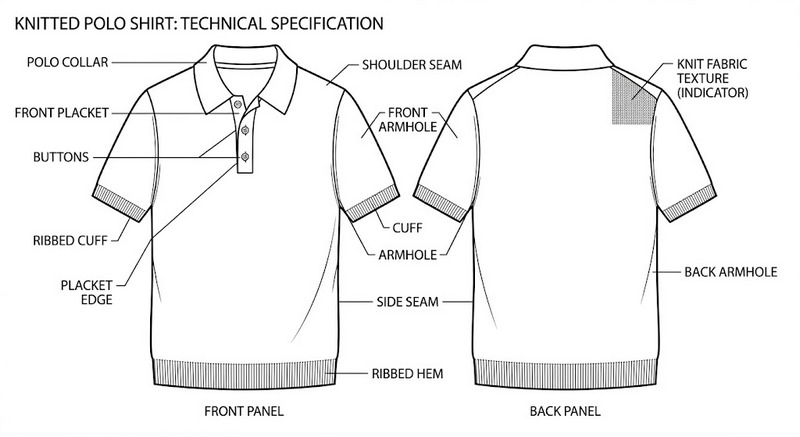
Half-moon and pocket are dependent upon the buyer requirements. If buyer added these items in their spec sheet, then you have to count these parts.
Their size should be taken from the pattern, not from an assumption. A small pocket can still move the total fabric booking when the order is large.
Sample Order Specification
Suppose,
Nike buyer has given an order of 20,000 pieces with the following specification.
100% cotton single jersey Knitted fabric for body parts (Body + Sleeve), Half-moon and Pocket. Where fabric GSM is 160gm.
1 × 1 Rib fabric for collar and Cuff. Where the fabric GSM is 220gm.
Item: Basic men’s s/slv Polo shirt
Merchandiser should find out accurate consumption before yarn and fabric booking. Buyer will provide a size measurement chart. Now he has to find out consumption based on the middle size of that measurement chart. We can select L size to get the consumption.
That middle-size approach is standard in merchandising, but I always recommend checking whether the grading spread is unusually wide. A slim fit and a relaxed fit can need different booking logic even when the buyer calls both “basic.”
Please find the following measurement chart to go-ahead
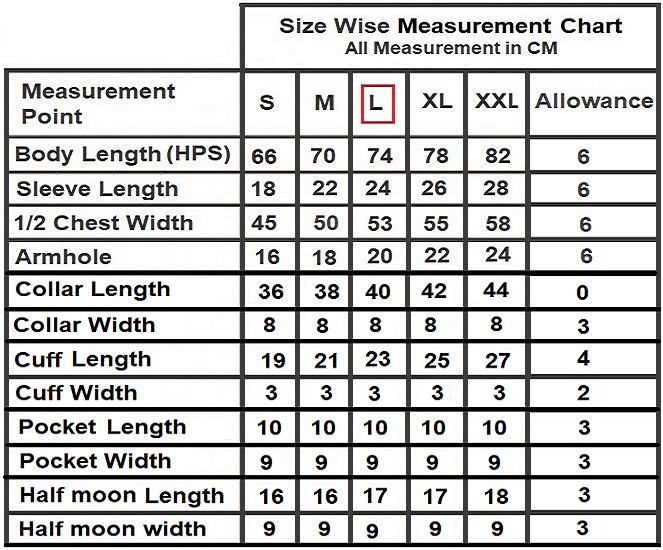
Polo shirt consumption and cost sheet usually prepare based on dozen. Formula will be same whether it is one piece or one dozen. There is two formula exists to prepare a basic Polo shirt consumption. European buyer always prefers CM to do measurement but USA buyer prefers inch to do measurement of garments product. You should know both formulas to become an expert merchandiser. Let’s find first formula to prepare basic Polo shirt consumption.
Since 1 dozen equals 12 pieces, the piece count must be converted carefully before bulk booking. Many factories keep the calculation in pieces first, then shift to dozen only for costing sheets and PO confirmation.
In practice, the second formula is often the safer one for production booking because it builds in real-world loss, not just textbook fabric area.
Now, we will find out the fabric consumption for the above order.
Before locking the booking figure, many factories check one pilot marker lay. That quick check often catches width variation, shrinkage, and lay loss before they become expensive.
Fabric Consumption Breakdown
1. Fabric consumption for Body parts (Body +Sleeve):
Here, we will follow the following formula (per dozen),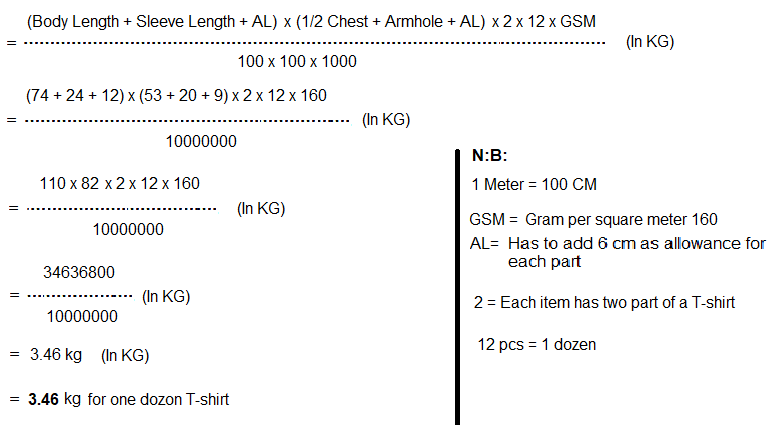
So, fabric’s consumption for Body parts (Body +Sleeve) is 3.46 kg per dozen.
2. Fabric’s consumption for Collar:
Here, we will follow the following formula (per dozen),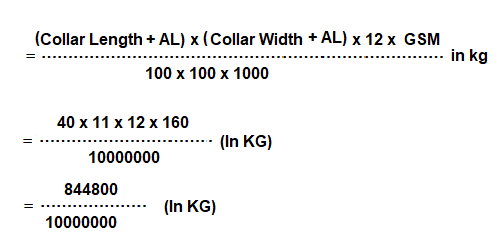
= 0.1161kg per dozen.
So, fabric’s consumption for Collar is 0.1161kg per dozen.
3. Fabric’s consumption for Cuff:
Here, we will follow the following formula (per dozen),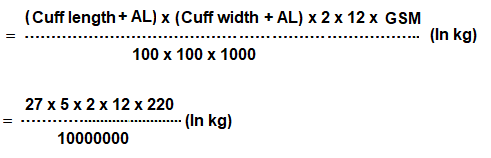
= 0.0712kg per dozen.
So, fabric’s consumption for Cuff is 0.0712kg per dozen.
4. Fabric’s consumption for Pocket:
Here, we will follow the following formula (per dozen),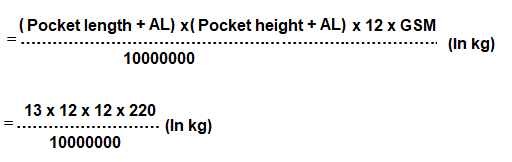
= 0.0411kg per dozen.
So, fabric’s consumption for Pocket is 0.0411kg per dozen.
5. Fabric’s consumption for Half-moon:
Here, we will follow the following formula (per dozen),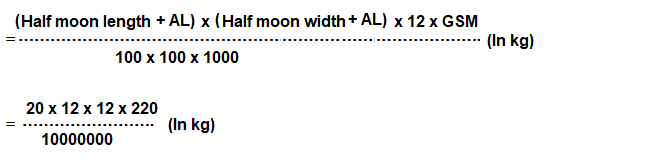
= 0.0633kg per dozen.
So, Fabric’s consumption for Half- moon is 0.0633kg per dozen.
Final Fabric Requirement
Now, total amount of single jersey cotton fabric needed for this order is (per dozen),
= [{Body parts Fabric consumption (Body +Sleeve) + Pocket Fabric consumption + Half- moon Fabric’s consumption} + wastage (10%)]
= {(3.46+ 0.0411+ 0.0633) kg + 10%}
= 3.56kg + 10%
= 3.91kg per dozen
In bulk orders, this is the number that should be compared against actual mill width, compacting shrinkage, and marker efficiency. A neat formula is useful only when the fabric behaves as expected on the cutting table.
So, for 20,000pcs (1666.66 dozen) polo shirts, cotton single jersey fabric needed (3.91 × 1666.66) = 6516.64kg
And,
Total amount of (1 × 1) Rib fabric needed for this order is (per dozen),
= {(Collar Fabric consumption + Cuff Fabric consumption) + wastage (10%)}
= {(0.1161 + 0.0712) kg + 10%}
= (0.1873kg + 10%)
= 0.2060kg per dozen.
1×1 rib is preferred here because it has better recovery for collar and cuff than single jersey. That is why the same weight formula should not be copied blindly from body fabric.
So, for 20,000pcs (1666.66 dozen) polo shirts, (1 × 1) Rib fabric needed (0.2060 × 1666.66) = 343.33kg.
A correct polo shirt consumption sheet saves money only when it matches real fabric behavior, not just the sample calculation.
Frequently Asked Questions (FAQs)
Q1. How do you calculate polo shirt fabric consumption?
Ans: Measure each component separately, calculate body fabric and rib fabric consumption from the approved pattern, and then add a practical wastage allowance. Convert the final kilograms into piece or dozen terms as required by the buyer or factory sheet.
Q2. What is the formula for polo shirt fabric consumption?
Ans: The simplest approach is to calculate the fabric area of each part, multiply by GSM, and convert the result to weight. For production planning, separate the body, collar, cuff, pocket, and half-moon so each component is costed correctly.
Q3. Why is the middle size used for polo shirt consumption?
Ans: The middle size gives a balanced base for costing because it sits between the smaller and larger graded sizes. If the style is highly fitted or has a wide size range, a factory may check more than one size before final booking.
Q4. How much wastage should be added in polo shirt fabric consumption?
Ans: Many factories use a planning allowance for cutting loss, shrinkage, and end loss. The exact percentage depends on fabric width, marker efficiency, and whether the mill has already compacted the fabric.
Q5. Does pocket and half-moon always count in polo shirt fabric consumption?
Ans: No. They only count when the buyer spec sheet includes them. Their actual impact depends on size and fabric type, so they should be measured from the pattern rather than estimated casually.