Last Updated on June 29, 2026
What Is Sewing Thread?
Thread is a common, subtle, twisty element. It should have considerable length with a marginal thickness which is made from raw cotton, wool, silk, yarn, linen, fiber, jute or, other substance formed of fibers or able to be spun or bamboo (organic thread) or other synthetic filaments with a cut edge in the cross section. Precise manner we can say, yarn is produced by spinning raw wool fibers, linen, cotton, or other material by a spinning wheel to prepare long strands known as yarn. For sewing, the best thread is one that is smooth, balanced, and able to pass through the needle without fraying or twisting out of shape. Thread is used to stitch and to sew fabric and other objects.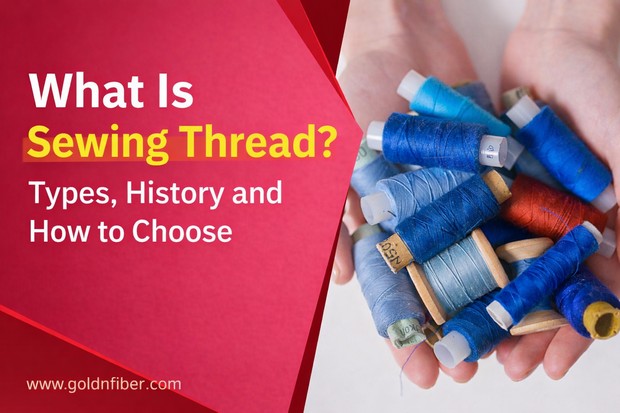
Early Sewing Thread History
Primeval era sewing threads were made out of animal hides by cutting them into thin strips; however, civilization improvements brought modifications in threads. Egyptians were efficient in making threads from plant fibers and wool and hair from tamed/pet animals. At that time threads were hand spun using spindles. That hand-spun method produced uneven thickness, so early seams were far less uniform than modern machine stitching. Even Egyptian queen Cleopatra wore the premium cotton grown in the Egyptian Nile Valley. Some scientists found cotton textiles about 5,000 years old from Mexico, according to Smithsonian research (2024).
Cotton thread was first spun by machinery in England in the mid-18th century, around 1764, according to the Science Museum (2024) and from then on it spread quickly like a wildfire around the world, thanks to the British Colonies. Cotton threads are built of the cellulose from plants and are used to stitch fabrics like rayon, linen, and cotton those also have plant origins. Plant-based fabrics may shrink, and the cotton thread has the same shrinkage attributes. If the fabric will be prewashed, the thread should be prewashed too or replaced with a low-shrink polyester thread to reduce seam puckering.
Embroidery and Silk in Ancient Civilizations
Embroidery process was invented about 1600 BC to 1100 BC by the Babylonians and the Assyrians. That date range is best read as a rough historical estimate because embroidery appeared in several early cultures, not just one. In the third millennium BCE, according to Encyclopaedia Britannica (2024), the queen of Emperor HoangTi, China was thriving in spinning great glossy silk threads out of silk cocoon. The Chinese and Japanese first discovered the beauties of silk fibers spun as thread and transform as cloth. Chinese emperor kept the secret method very long time around their country but in the 5th Century AD, two priests were able to know the secret way and take the secret outside China to Rome with carefully. From there it expands across the world. Silk production stayed highly guarded for centuries, which is why it became such a valuable luxury fiber in Eurasian trade.
Sewing Machine Development
Sewing machine stitches fabrics and other materials together with thread. The sewing machine was invented during the first Industrial Revolution; however, the most improved, efficient and productive but price flexible industrial sewing machine was designed by an English man named Thomas Saint in 1790, according to the Science Museum (2024). Saint’s design was an early prototype, while practical factory machines came later in the 19th century.
From Viscose to Synthetic Fibers
Yarns and fabric from viscose art silk came in 1892, according to Encyclopaedia Britannica (2024). In the 1930s, according to Encyclopaedia Britannica (2024), German Chemists manufactured textile fibers from Vinyl Chloride. First artificial textile fiber from polyvinyl-chloride was spun by 1931 Heinrich Papst, Hermann Hecht and Emil Hubert in 1931. This progress was marked as the year of birth of synthetic fibers. It showed that textile fibers could also be engineered from petroleum-based raw materials, not only from plants or animals.
Rayon and Artificial Silk
In 1884, first time synthetic silk invented by Earl Hilaire de from solute cellulose. But the first industrial artificial silk was produced in 1891. The term “synthetic Silk” was renamed as “Rayon” in 1924. The industry later standardized rayon as the commercial name, which helped buyers distinguish regenerated cellulose from true silk.
Polyester and Nylon in Sewing Thread
British chemists J. R. Whinfield and J.T. Dickson were originated Polyester fibers in 1941. But actually, Polyester threads launched its production from 1953, according to Encyclopaedia Britannica (2024). These artificial threads had greater mechanical advancement in than silk threads and in the 1970s artificial threads became more admired in comparison to silk threads cause silk were also costlier than synthetic fibers. Polyester and nylon threads are preferred for synthetics and stretch knits. Both types of synthetic threads have the same attributes including high strength, no shrinkage, and excellent abilities to stretch and regain that make them appropriate for knits, sheers, and preshrunk fabrics. That popularity matches the wider fiber market too, since polyester accounted for about 57% of global fiber production in 2022, according to Textile Exchange’s 2023 Materials Market Report. Polyester and nylon are the only threads that can be done from a single ply or single yarn. For stretch knits, a ballpoint needle and careful tension are just as important as the thread itself. Thread construction is not limited that way in practice, because many cotton, rayon, and specialty threads also come in different plies and finishes.
Why Natural Silk Still Matters
But even today, natural silk has great appeal and usually used widely for making high-quality wearer for fashion conscious people. It is still chosen for premium garments, hand finishing, and decorative sewing where sheen matters more than maximum abrasion resistance.
Major Sewing Thread Manufacturers
Coats, American and Efird (A & E) are two largest thread manufacturers in the world and produce a quality full immense quantity of thread with thousands of colors. These two thread manufacturers doing business by setting up thread industry in the several places of the world to meet apparel industries demand. Their product ranges usually include spun polyester, core-spun constructions, nylon, and specialty threads because different seams demand different stretch and abrasion levels. Sewing threads are specially designed yarn which is able to perform stitches quickly and efficiently. Sewing threads should form stable, uniform seams and fine stitches. In practice, the right thread should improve seam appearance without forcing the machine to work harder.
Key Features of Sewing Threads
Sewing threads must have the following features:
- Color fastness
- Shade matching
- Right stitch formation etc.
Sewing threads must have sufficient longevity, abrasion to resistance, elasticity, color fastness etc. And must endure needle heat, chemical and physical forces of garment care thread flaw leads to skipped stitches, thread breakage, uneven stitches, seam puckering etc. Sew-ability of sewing thread depends on right loop formation and resistance to thread breakage. Sewing threads are manufactured from cotton, polyester, nylon, and rayon. Silk threads find application in high-quality garments. If you are buying thread for apparel, color fastness and stitch performance matter more than brand name alone. Skipped stitches are often caused by the wrong needle size, a dull needle, or incorrect tension, not just by the thread itself. Linen finds application in shoe making. Cotton, rayon, and silk have lower tenacity and elasticity, but they quickly dye with a wide variety of colors and possess excellent sew-ability. That is why they are often chosen when appearance and dyeability matter more than raw strength.
Cotton Sewing Threads
Cotton sewing threads: Previously it was the most favorite sewing threads. But because of low strength, poor elasticity and low abrasion resistance it has lost its place to polyester threads. Cotton threads are vulnerable to breakage and also higher in price. It has higher shrinkage value leading to seam pucker but cotton threads are familiar to all as an environment-friendly item. They are still useful for quilting, heirloom sewing, and natural-fiber garments where a matte finish is preferred.
Polyester and Nylon
Sewing threads: These are strong threads and possess high tenacity and abrasion resistance. They attain high seam strength in comparison to comparable cotton threads.
Nylon threads have higher elongation that is vulnerable to skip stitches and seam puckering. Synthetic threads are more compatible with comparable fabrics. Nowadays polyester threads have become more popular and versatile. Nylon is often chosen for bags, swimwear, and upholstery, while polyester is the more common all-round garment thread. When sewing knits or stretch fabrics, use a stretch-friendly thread and adjust tension rather than forcing a cotton thread to do the job.
Special Sewing Threads
Special Sewing Threads: Beside this there are some threads which make special requirements from special fibers. So they use special fibers to cater to the individual needs. Some particular thread is also treated after spinning and depending on its use. Metallic thread is used for decoration but it is sensitive to heat and steam and must be handled with care. Garments made of fabric treated with water repellent are also sewn with treated thread. Aramid threads, Gore-Tex, Aluminum thread, Carbon thread, surgical thread are examples. A simple shop-floor test is to sew a scrap first, because metallic and coated threads often need a larger needle, slower speed, and looser tension. Heat, steam, and pressing temperature should be checked before stitching decorative or technical threads, because some finishes degrade quickly.
Thread Blends and Core-Spun Construction
Thread also can be made of various amalgamations of fiber. Thread with a core of polyester and an external wrap of cotton, rayon or spun polyester combines the attributes of both fibers, with the outer fiber creating the appearance or finish of the thread. This construction is popular in apparel because it gives strength from the core and a cleaner, more natural look from the wrap.
Choosing the right thread is mostly about matching fiber, strength, shrinkage, and heat resistance to the fabric and the stitch job. When those four points line up, seams look cleaner and last longer.
Conclusion
Choosing thread by fabric type, stitch purpose, and machine setting gives better seam strength and fewer sewing problems. For most garments, that simple match matters more than choosing the most expensive spool.
Frequently Asked Questions (FAQs)
Q1. Which thread is best for sewing clothes?
Ans: Polyester thread is usually the best all-purpose choice for sewing clothes because it is strong, low-shrink, and works on both woven and knit fabrics. Cotton thread is better for natural-fiber looks and quilting, but it is less durable in many garment seams.
Q2. What thread should I use for stretch fabric?
Ans: Polyester or nylon thread is usually the better choice for stretch fabric because both can move with the cloth without breaking as easily as cotton. A ballpoint or stretch needle also helps the stitch form cleanly on knits.
Q3. Why does my sewing thread keep breaking?
Ans: The most common causes are a dull needle, the wrong needle size, poor tension, or low-quality thread. Re-threading the machine and changing the needle often fixes the problem before the thread itself is blamed.
Q4. Is cotton thread better than polyester thread?
Ans: Cotton thread is a good choice for quilting, natural-fiber garments, and a matte finish. Polyester is usually stronger, stretches a little more, and shrinks less, so it is the better everyday option for most clothing.