Last Updated on May 22, 2026
Fashion merchandising is how you plan, buy, and sell fashion products. It makes sure the right items reach the right customer at the right time and price. It links design, factories, and stores using data and market insights.
What Is Fashion Merchandising?
Fashion merchandising is the core of the global fashion industry. It turns a sketch into a product you can buy. It aligns design, making, pricing, and ads to make money.
What it does:
- Studies what customers want
- Plans product lines
- Manages when things get made
- Handles buying and stock
- Shows products in stores or online to drive sales
In simple terms:
Fashion merchandising makes sure what gets made matches what customers want — when and where they want it.
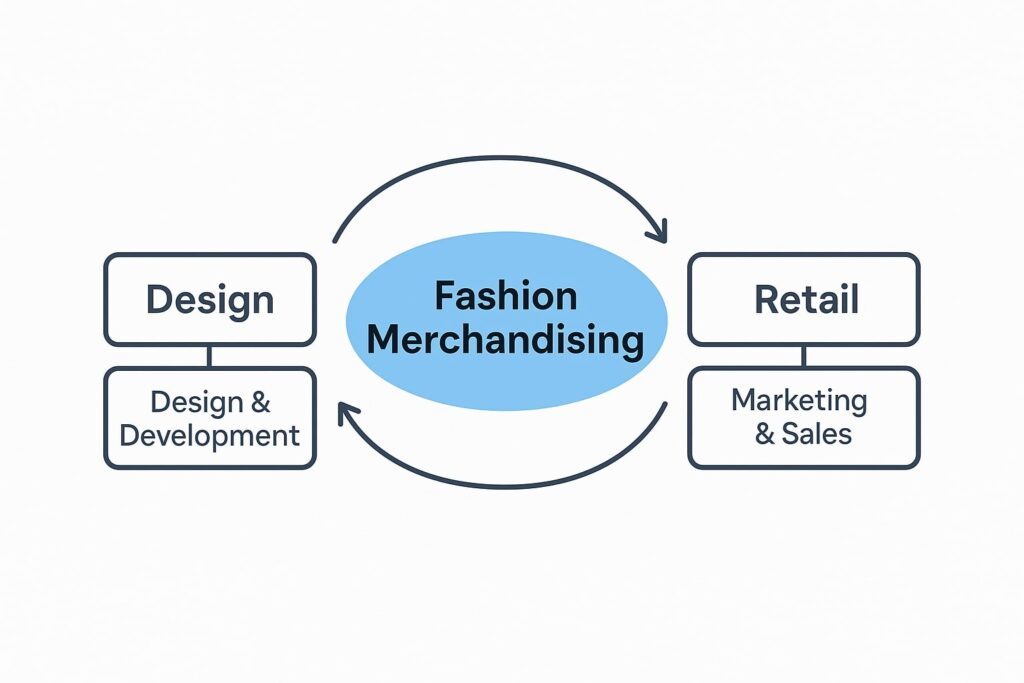
How Fashion Merchandising Connects Everything
Fashion merchandising links creative and business teams. It sits between:
- Design & Product Making – turning ideas into samples
- Production & Sourcing – managing fabric and factory times
- Marketing & Sales – launching products to make profit
Fashion Merchandising vs. Other Jobs
| Job | Main Focus | What They Do |
|---|---|---|
| Fashion Merchandising | Planning and doing | Product planning, forecasting, coordination |
| Buying | Buying items | Picking and buying products |
| Visual Merchandising | How things look | Store layout and displays |
Key point: Buying is what you stock. Visual merchandising is how you show it. Fashion merchandising is why, when, and for whom you do it.
The Fashion Merchandising Process – Step by Step
The process goes from concept to customer feedback.
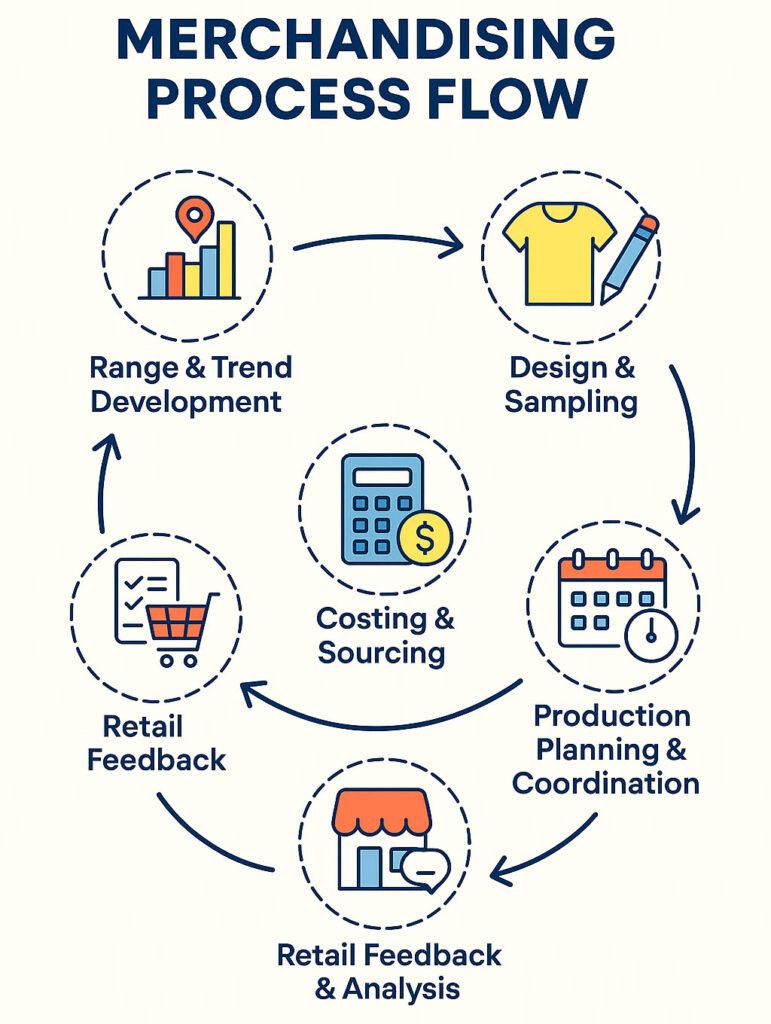
1. Range & Trend Development
Every journey starts with trend forecasting. You look at runways, social media, and past sales to predict what customers will want next season.
Tools like WGSN or Edited help find key colors, fabrics, and styles.
In Bangladesh’s export industry, buyers share plans based on Western trends. Merchandisers adapt these for local production times.
2. Design & Sampling
Once trends are set, the team works with designers to make real prototypes. Merchandisers make sure each sample fits cost, time, and quality goals.
Steps:
- Make tech pack
- Source fabric & lab dips
- Approve sample (fit, color, pre-production)
Time needed: 4–6 weeks from idea to final approval.
3. Costing & Sourcing
Merchandisers look at material costs, labor, and shipping to set good prices.
In export merchandising (like Bangladesh), price talks with buyers and suppliers matter a lot.
Cost breakdown (making clothes):
| Part | Percent of Total Cost |
|---|---|
| Fabric & Trims | 55–65% |
| Labor & Overheads | 20–25% |
| Shipping & Compliance | 5–10% |
| Profit | 8–12% |
4. Production Planning & Coordination
Once orders are set, merchandisers schedule production. They make sure fabric arrives and cutting, sewing, finishing, and checks meet deadlines.
Time benchmarks (Bangladesh):
| Stage | Time Needed |
|---|---|
| Fabric sourcing | 15–25 days |
| Production | 30–45 days |
| Shipment & logistics | 10–15 days |
5. Buying & Assortment Planning
Retail merchandisers plan the product mix across seasons and price points.
They balance depth vs breadth — how many styles, sizes, and colors to stock without buying too much.
Checklist:
- Look at past sales & markdown reports
- Plan OTB (Open-to-Buy) budgets
- Split stock per store/channel
6. Distribution & Retail Feedback
Finished goods go to stores or online. Merchandisers track sales and customer feedback to plan next season.
Tools used: ERP dashboards, POS analytics, Google Trends, and social listening platforms.
Core Principles & KPIs of Good Fashion Merchandising
The timeless “Three Rs” — Right Product, Right Time, Right Price — have grown into the Five Rs for 2025:
Right Product, Right Time, Right Price, Right Channel, Right Customer.
Key KPIs for Fashion Merchandisers (2024–25)
| KPI | What It Means | Good Range (2024-25) |
|---|---|---|
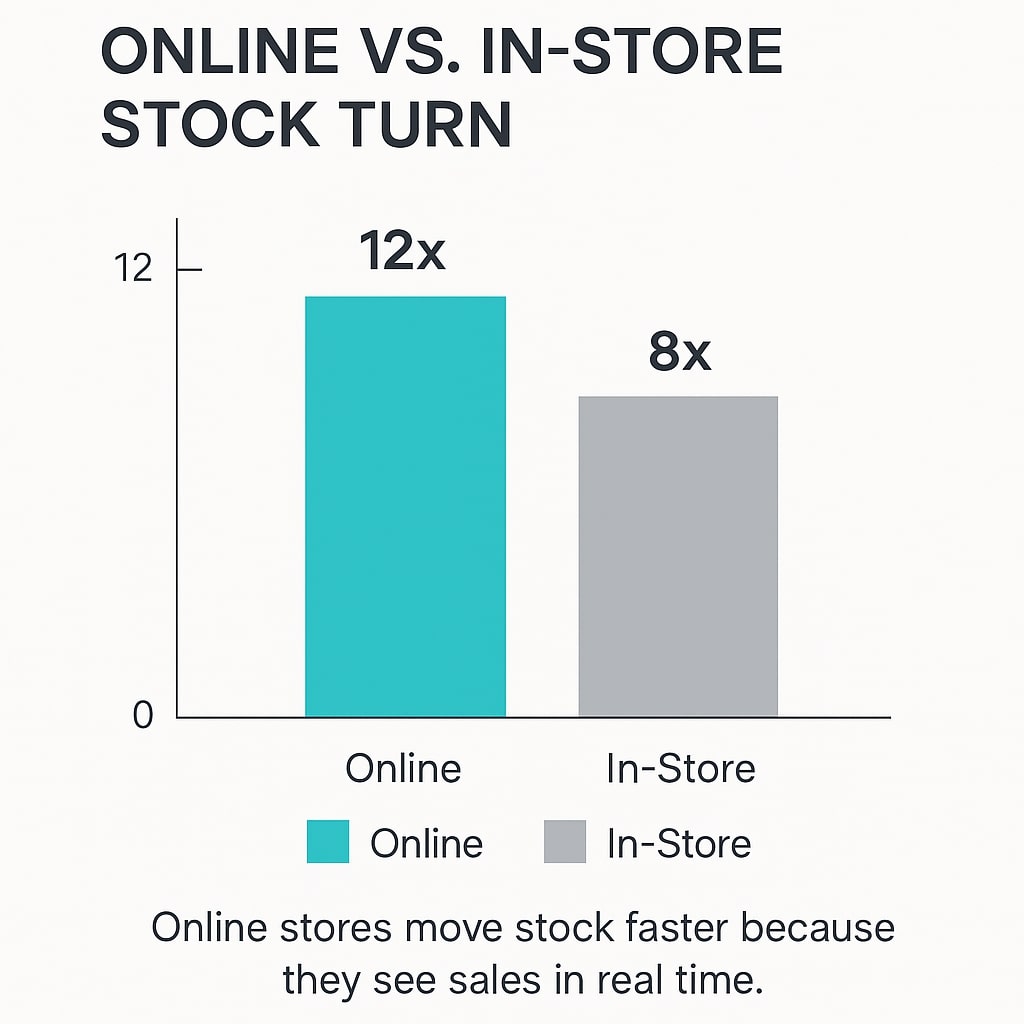
| Sell-through Rate | % of stock sold vs received | 70–85% (retail average) |
| Stock Turn | Times inventory sold/year | 6–10× |
| Gross Margin % | (Revenue − COGS) / Revenue | 45–60% |
| Markdown % | Discounts vs original price | 10–20% |
| Weeks of Supply | Average stock / weekly sales | 8–10 weeks |
| Lead Time | Concept → Store delivery | 90–120 days (fast-fashion ≤ 30 days) |
Note:
“A 5% boost in sell-through can raise gross margin by 2–3%, helping profit directly.”
Roles & Skills of a Modern Fashion Merchandiser
Fashion merchandising roles have changed with digital tools and green priorities.
| Role Type | Main Focus | Key Skills |
|---|---|---|
| Manufacturing Merchandiser | Links buyer & factory | Sampling, costing, talking, quality control |
| Retail Merchandiser | Plans mix & pricing | Data analysis, category management, forecasting |
| E-commerce Merchandiser | Online product success | SEO for products, digital analytics, UI/UX awareness |
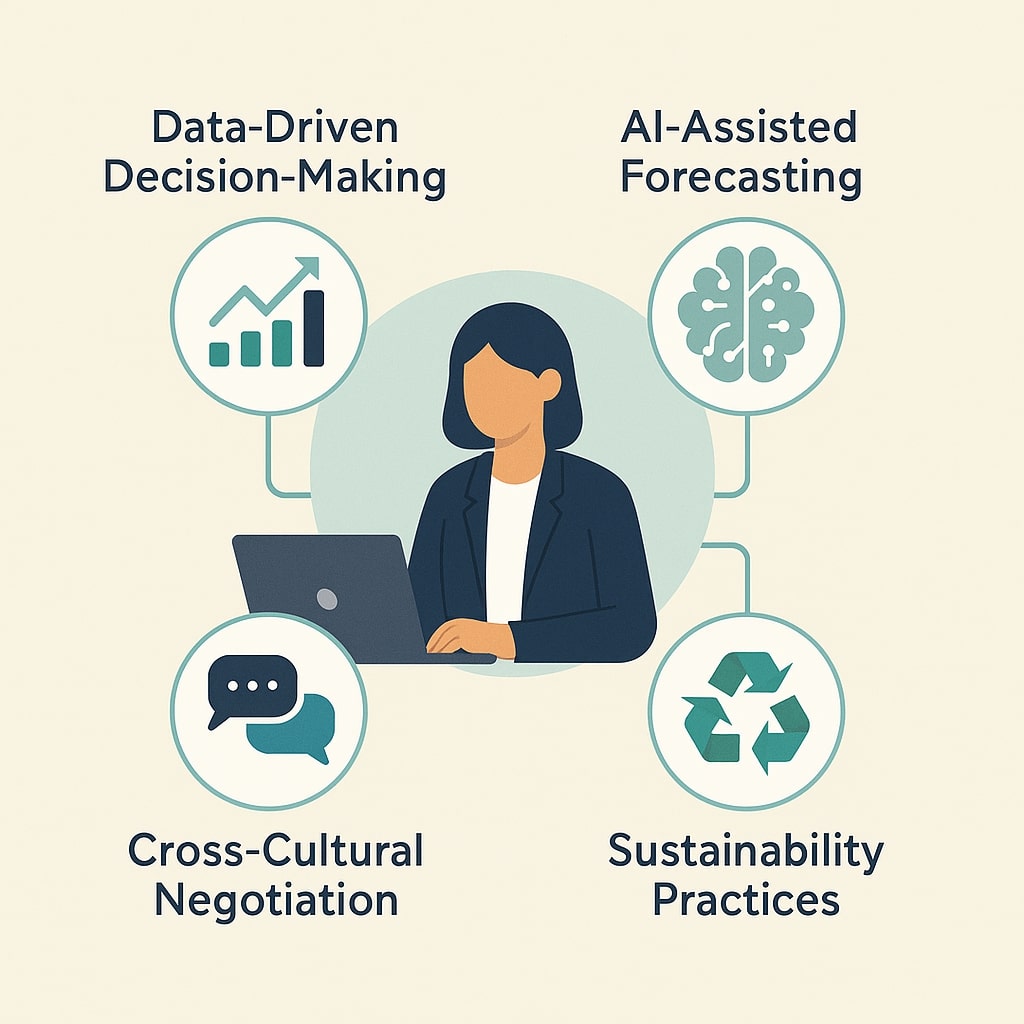
Top Skills in Demand (2025)
- Data-driven choices
- AI-assisted forecasting tools
- Green sourcing & traceability
- 3D sampling & virtual fitting
- Cross-cultural negotiation skills
Bangladesh Insight: Export merchandisers now need to master digital sampling and online buyer tools to compete with Vietnam and India.
Trends & New Ideas Shaping Fashion Merchandising in 2025
1. Digital Change
AI and data now inform range planning, price setting, and stock refills. Platforms like Centric PLM and BlueCherry ERP are common.
Brands using data-driven pricing see up to 20% better sell-through.
2. Omnichannel & Social Commerce
Shoppers move between Instagram, e-commerce, and stores easily. Merchandisers must plan linked inventory systems that sync across channels.
Example: Zara and Uniqlo have unified SKU systems allowing live stock visibility.
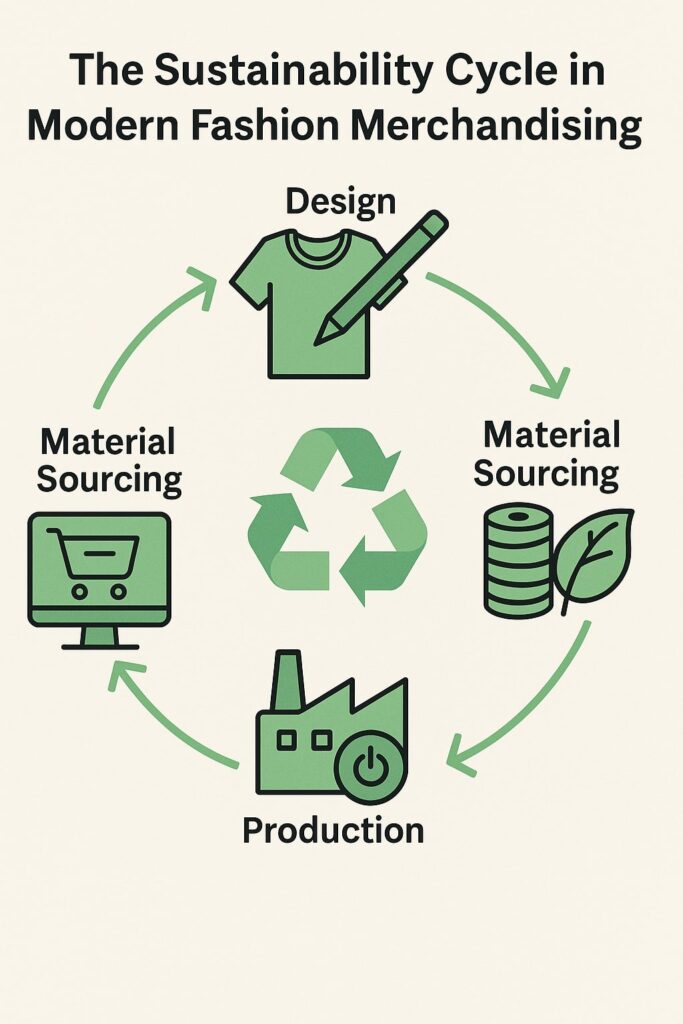
3. Sustainability & Ethical Sourcing
Customers want transparency. Merchandisers help reduce overproduction and add circular practices.
Green approaches:
- Forecast based on real demand data
- Use organic/recycled materials
- Use on-demand production models
4. Regional Growth: Bangladesh & South Asia
Bangladesh is the world’s second-largest apparel exporter. Merchandisers here play a dual role — linking global brands and local makers.
Bangladesh RMG Export Performance
| Fiscal Year | Export Value (USD Bn) | Growth % | Source |
|---|---|---|---|
| 2023-24 | 36.15 | – | BGMEA |
| 2024-25 | 39.35 | +8.84% | Textile Focus |
| 2025 (Est.) | >40 | Projected | Gold n Fiber Est. |
Case Studies in Fashion Merchandising
Case 1: Fast-Fashion Retailer (Zara)
Zara’s real-time merchandising model turns concept-to-store in ~25 days.
- Weekly data updates from POS systems inform designers.
- Flexible making networks in Spain & Portugal enable speed.
Outcome: High sell-through (>85%) and minimal markdowns (<15%).
Case 2: Bangladesh Export Factory (Example: Chattogram Unit)
A local garment factory used digital merchandising software for sampling & buyer tracking.
Result:
- Sample approval time cut from 21 days → 12 days
- Order accuracy up by 18%
- Better buyer confidence = repeat orders
| Metric | Before | After |
|---|---|---|
| Sample Approval Time | 21 days | 12 days |
| Order Accuracy | 82% | 97% |
| Buyer Satisfaction Score | 3.8/5 | 4.6/5 |
Lesson: Digital change in merchandising creates real ROI for export houses and retailers.
Practical Toolkit & Downloads for Merchandisers
Here are resources you can use right away.
- Assortment Plan Template (Excel) – Pre-built grid for category mix & budgeting.
- Weekly Merchandiser Dashboard (Google Sheet) – Auto-calculates sell-through & stock-turn.
- Skill Assessment Checklist (PDF) – Evaluate your strengths & training needs.
- KPI Benchmark Table 2025 – Editable reference sheet.
Tip: Offer these as downloads to capture emails and build engagement on Gold n Fiber.
FAQs about Fashion Merchandising
Q1: What is the difference between a buyer and a merchandiser?
A buyer decides what to buy. A merchandiser plans what, when, and how much to sell — linking creative ideas with sales strategy.
Q2: Is fashion merchandising a good career in Bangladesh?
Yes. With Bangladesh’s $39 billion export industry, merchandising offers high demand roles in sourcing, production, and buying offices.
Q3: How is digital technology changing merchandising?
AI forecasting, 3D sampling, and real-time inventory systems reduce waste and speed up choices.
Q4: What are the top skills for merchandisers in 2025?
Analytical thinking, communication, digital tool literacy, and sustainability awareness.
Q5: What tools can help merchandisers track performance?
PLM software (Centric, BlueCherry), Excel/Google Sheets dashboards, and POS analytics systems.
Conclusion
Fashion merchandising has evolved from manual planning to data-driven strategy. It’s no longer just about products — it’s about timing, technology, and sustainability.
For Bangladesh and other South Asian nations, merchandisers remain the unseen architects behind global fashion success — balancing creativity and commerce in a fast-changing world.
By using digital tools and green strategies, today’s merchandisers can shape a profitable and responsible future for fashion.
References & Sources
- Grand View Research (2024): Global Apparel Market Report
- Uniform Market (2025): Apparel Industry Statistics
- BGMEA (2024): Export Performance Data
- Textile Focus (2025): RMG Export Growth in Bangladesh
- Gold n Fiber Research Estimates (2025)