Last Updated on July 21, 2026
Introduction
Pattern section should be well equipped to get an optimal result in sample development as well as bulk production. A small, well organized toolkit also saves time during repeated fit revisions and style changes. Garment manufacturers have to provide all necessary pattern making tools and supplies to pattern-makers to work efficiently. Keeping the tools clean and in fixed places also helps new staff find the right item quickly. To minimize errors and misunderstanding the pattern maker should know and recognize some terminology related word with pattern-making tools for getting better communication with the coworkers.
List of Pattern Making Tools and Their Function in Details
There are different sort of pattern making tools exist which are vastly used in the apparel industry. I have tried to compile their entire name with their functions and specifications in details: This list covers the tools most often used in manual drafting, sample correction, and size development, so it is useful for both beginners and production teams.
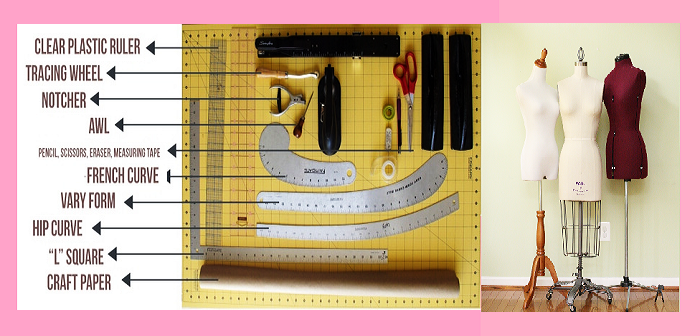
- Dummy Doll
- Digitize table,
- Black twill tape,
- Curve rules,
- Pencils and pens,
- Rulers,
- Metal weight,
- Measuring tape,
- Magic mend scotch tape,
- Hanger hooks or ringers,
- Push pins,
- Notcher,
- Normal Table
- Tracing wheels,
- Straight pins,
- Straight pin holder,
- Scissors,
- Tailor’s chalk
- Awl or hole maker
- Miscellaneous Tools
The entire above pattern making tools have explained in the below with their function:
- Dummy doll: It is one of the most important parts in the pattern section. Dummy doll helps pattern maker to fix garment measurement accurately. It also helps to make pattern grading from one size to another size. For best fit control, the dummy should match the target size or be adjustable, otherwise the sample will hide measurement errors instead of showing them.
- Digitize table: Sometime buyer may send paper pattern to copy and develop sample. It is one sort of pattern table which can transform manual paper pattern to computerized digital pattern. When a paper pattern is digitized, keep every piece labeled before copying so the digital file stays organized.
- Black twill tape: Black twill tape is used for the placement of style lines on garments. It is especially helpful when style lines need to be seen clearly on a busy pattern sheet.
- Curve rules: French curve is a bunch of curve rules used for shaping armhole and neckline. This is made of clear plastic. It helps in marking shapes of the neck, depth of sides and bottom of the garments. Choose the curve that matches the line first, then smooth the shape by eye instead of forcing one curve rule to do every job.
- Pencils and pens: Pencil is used for marking on pattern paper. Particular color pens and pencils are used to accomplish a particular task. Usually red, black, green and blue felt tip pens are used for pattern information. But Red and blue colored pencils are used to identify pattern changes. Mechanical pencil and sharpener are used for pattern work. Keeping one pencil only for rough drafting and another for corrections makes revisions easier to read.
- Rulers: It is one of the best devices for taking long straight measurements. It is mostly used for checking grain lines and marking hems. Tailors square (24 × 14) inch metal ruler with two arms forming a 90® angle that measures, rules, and squares simultaneously that is also used to triangle with the measurements to straight lines. A square ruler is especially helpful when checking right angles, seam lines, and center fronts and backs before cutting.
- Metal weight: Metal weight is a big iron to keep upon the pattern papers for tracing and marking perfectly. Pattern weights work better than pins on delicate paper because they hold the sheet without creating extra holes.
- Measuring tape: It is a unique tool for taking body measurements. It is 152 cm or 60″ long with measurements on both sides. Measuring tools are the most essential things in making a garment pattern. It is used to measure the size of the pattern. The success rate of garment construction mostly depends upon in taking accurate measurements of the subject and by using the appropriate tool for pattern making. For the most reliable body measurement, keep the tape level and snug, but never tight against the body.
- Magic mend scotch tape: It is used to patch pattern work. It will help to attach pattern paper with a dummy. Use only a small strip so the repaired area stays flat and does not distort the pattern line.
- Hanger hooks or ringers: It is used to hold the patterns together for hanging on rods. It helps to keep pattern papers well. Label the hanger with style number and size range to avoid mixing multi size sets.
- Push pins: Push pins are used for pattern separation and segregation. It also prevents pattern paper slippage when cutting several piles of paper together. Use push pins on the board only, not directly on paper edges that must stay clean for tracing.
- Notcher: It is used to indicate seam allowance, center line and also to identify front and back of patterns. These indications help sewers to assemble garment parts promptly. Keep notch marks consistent across all matching pieces so sewing operators can align them quickly.
- Normal Table: Normal flat or 45° vertical table helps to cut and develop paper patterns quickly. A clean, level table also helps reduce paper shifting, which is important when several pieces are being traced at once.
- Tracing wheels: It is used to transfer pattern shape into the paper to develop sample. Choose a wheel with the right point type for the paper weight, because a dull wheel will miss the line and a sharp one can tear thin paper.
- Straight pins: Dressmaker used it for wrapping and fitting. Use fine, rust free pins for fitting so they do not leave large holes in test garments.
- Straight pin holder: Pincushion or magnetic holder which is used for wrist and table. A magnetic holder is useful when you need to collect stray pins quickly and keep the table safe.
- Scissors: There are different types of scissors such as paper scissor, pinking scissors, embroidery scissors, big scissors for fabric cutting etc. Keep one pair only for paper and another only for fabric, because mixing them shortens blade life and affects cutting accuracy.
- Tailor’s chalk: Tailor’s chalk is used for making adjusted seams and style lines. It is made of china clay and is available in different colors. It is used for marking the paper patterns on the cloth. Alterations and construction markings are drawn using tailor’s chalk. Test the chalk on a scrap first, especially on light or delicate fabrics, because some marks are harder to remove than others.
- Awl or hole maker: It is used to indicate the ending of darts, pocket, trim and buttonhole placements. It is a sharp-edged instrument with a handle. This is used to make buttonholes. Use it carefully on a cutting mat so the paper does not tear beyond the marked point.
- Miscellaneous tools: Besides this, some other tools and equipment’s may be required in patter section like anti-cutter, rotary cutting wheel, adjustable seam gauge, adjustable ruler etc. Keeping these items in a separate tray makes them easier to find during sample checking.
Choosing the right pattern making tools and keeping them organized helps the sample room work faster, reduces rework, and improves fit accuracy from the first sample to bulk production.
Frequently Asked Questions (FAQs)
Q1. What are the essential pattern making tools for beginners?
Ans: The core starter tools are measuring tape, rulers, curve rules, pencils, scissors, tracing wheel, pattern weights, and a notcher. These tools are enough for most hand drafted patterns and basic sample corrections.
Q2. What is a notcher used for in pattern making?
Ans: A notcher marks matching points on pattern pieces so seams, darts, and style details line up during sewing. It reduces confusion in the sample room and helps the garment go together faster.
Q3. What is pattern grading in garment industry?
Ans: Pattern grading is the process of increasing or decreasing a base pattern to create other sizes. It is usually done after the base fit is approved so every size keeps the same shape and balance.
Q4. Do I need a digitizing table for pattern making?
Ans: No, you can draft patterns by hand with paper, rulers, and curve rules. A digitizing table is helpful when you need to convert paper patterns into digital files for editing, storage, or grading.