Introduction
In garment manufacturing, seam choice affects how a product looks, how it is finished, and how it moves through production. Technical designers and production engineers rely on clear seam specifications so the right construction method is used every time. ASTM D6193 and ISO 4916 provide the standard language for those seam types. Once the basic terms are clear, the classification system becomes much easier to follow.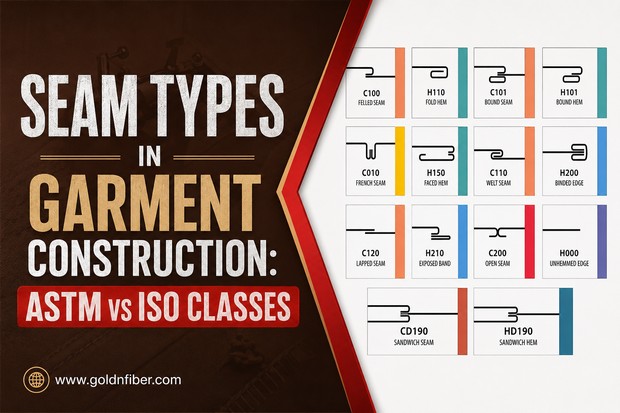
Seam Basics
A seam is the result of joining together two or more pieces of fabric by means of stitching or thermal bonding. Seams are functional and may be used for decorative purposes. Lines and design features are expressed through seams in garments. A seam line is the designated line along which the seam is to be joined. A seam allowance is the distance from the fabric edge to the stitching line farthest from the edge. Technical designers plan seam allowance according to the width needed for the type of seam, seam finish, or garment design. Most seams are constructed on the inside, or wrong side, of the garment.
ASTM D6193 and ISO 4916 Seam Classification
Production engineers require numbered specifications for seams to avoid confusion in production operations. The industry follows ASTM D6193 Standard Practice for Stitches and Seams or ISO 4916 International Standard for Textiles, Seam types, Classification and terminology. ASTM D6193 divides seams into six classifications. Each seam class is identified by two or more uppercase letters that classify the seam, followed by one or two lowercase letters identifying the type of seam within the class, and one or more numbers indicating the number of rows of stitching within the seam.
ISO 4916 divides seams into eight classifications. Each seam class is identified by a numeric sequence containing five digits. The first number identifies the seam class (1 to 8) and is followed by a period. The second and third double-digit numerals (01 to 82) designate differences in fabric configurations that relate to the number of components within the seam and are followed by a period. The fourth and fifth double-digit numerals (01 to 12) distinguish the needle position and penetrations or passages through the fabric to create the seam.
ASTM D6193 seam classes include
- SS Superimposed Seams
- LS Lapped Seams
- BS Bound Seams
- FS Flat Seams
- OS Ornamental Seams
- EF Edge Finish Seams
ISO 4916 seam classes include
- Seam Class 1: Seam Class 5
- Seam Class 2: Seam Class 6
- Seam Class 3: Seam Class 7
- Seam Class 4: Seam Class 8
The type of seam selected depends on
- Fabric type
- Garment use
- Seam placement or position
- Retail price point
- Garment care
Superimposed Seams (SS Class) and Class 1 Seams
A category of seams in which two or more plies of fabric are overlaid, one on top of the other with raw edges aligned, and sewn together at a designated distance from the raw edge, with one or more rows of stitching. Seams within this class are produced in a single- or two-step operation. When seams are constructed in a single operation, the fabric plies are superimposed with raw edges aligned and stitched on the designated seam line. For seams constructed using a two-step process, known as an enclosed seam, the raw edges are folded and concealed within the layers of material that compose the seam. When the seam allowance of a superimposed seam is pressed open, it is referred to as a booked seam. The ISO Class 1 seams are primarily superimposed, although there are a few lapped and flat seams included as well. Superimposed and Class 1 seams are the most common for apparel construction.
ASTM and ISO stitch classifications commonly used in the construction of superimposed seams include
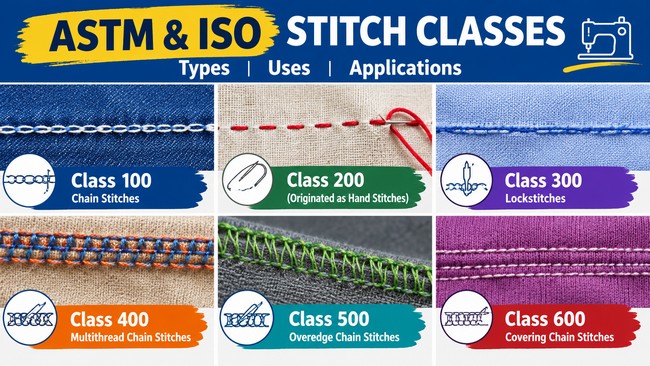
- 100 Class Chain Stitches
- 300 Class Lockstitches
- 400 Class Multithread Chain Stitches
- 500 Class Overedge Chain Stitches
There are 55 superimposed seam configurations and 26 Class 1 seam variations. Superimposed and Class 1 seams are used for
- Main seaming in dresses, blouses, shirts, skirts, jeans, trousers, pants, shorts, jackets, coats, and pajamas
- Garments containing a lining
- Cut and sew sweaters and knit garments
- Outer edges of collars, cuffs, necklines, waistbands, and waistlines
- Attaching interlinings
- Attaching buttonhole strips
- Garments made of sheer fabrics such as chiffon, organza, georgette, and organdy where the seam finish may show
Several types of superimposed seams are frequently used in garment construction. Their ISO seam class equivalencies include
- SSa Seam Type = 1.01 Seam Type
- SSh Seam Type = 4.03 Seam Type
- SSk Seam Type = 1.12 Seam Type
- SSab Seam Type = 1.23 Seam Type
- SSae Seam Type = 1.06 Seam Type
- SSag Seam Type = 4.10 Seam Type
- SSaw Seam Type = 2.19 Seam Type
SSa and 1.01 Seam Types
Plain seams, the most commonly used within this classification, are selected for general seaming on straight or curved areas.
SSh and 4.03 Seam Types
Narrow seams used on garment main seams such as sweatshirt side seams. SSh and 4.03 seams are constructed; then the seam allowance is pressed open and stitched again with a cover stitch.
SSk and 1.12 Seam Types
Piped seams that add decorative detail to a garment. Piping or cording inserted into the seam as an additional ply during construction.
SSab and 1.23 Seam Types
Taped seams employ twill tape, clear elastic tape, or shell (self) fabric at necklines, shoulder seams, and waistlines of garments to add stability and reinforcement.
SSae and 1.06 Seam Types
French seams, essentially constructed as a seam encased within a seam, are used for straight main seaming within a garment to enclose the raw edges of lightweight or sheer fabrics prone to raveling.
SSag and 4.10 Seam Types
Bias tape reinforces shoulder seams of knitted garments and conceals the raw edges of seams in unlined jackets in strapped seams.
Lapped Seams (LS Class) and Class 2 Seams
A category of seams in which two or more plies of fabric are overlapped with the raw edges exposed, for fabrics resistant to raveling, or the seam allowance is folded under and stitched with one or more rows of stitching. Common ASTM and ISO stitch classifications in the construction of lapped seams include
- 300 Class Lockstitches
- 400 Class Multithread Chain Stitches
This class includes 101 lapped seam configurations and 46 Class 2 seam variations. Lapped and Class 2 seams are used for
- Main seaming of denim jackets, jeans, and overalls
- Fabrics that will not ravel such as leather, suede, Melton, felt, lace
- Unlined garments
- Side seams of shirts
- Joining lace to another fabric
- Attaching patch pockets
- Joining garment sections such as a yoke, gusset, or godet to other garment sections
- Seams where stitching is desired as a decorative finish
Frequently used lapped seams in garment construction and their ISO equivalencies include
- LSc Seam Type = 2.04
- LSd Seam Type = 5.31
- LSq Seam Type = 2.02.03
- LSbm Seam Type = 2.02
LSc and 2.04 Seam Types
Flat felled seams encase all raw edges inside the seam and are used for straight main seaming of garments where strength and durability are desired.
LSq and 2.02.03 Seam Types
Welt seams do not encase all raw edges in the seam and are constructed using an SSa seam that is turned back and secured with one or more rows of stitching. Welt seams provide the appearance of a flat felled seam on the face of the garment but have raw edges that show on the back side.
LSbm and 2.02 Seam Types
Similar to LSq seams, the welt seam does not encase all raw edges in the seam and is constructed using an SSa-2 seam and one row of overedge stitches and is turned back and secured with one or more rows of stitching. Welt seams provide the appearance of a flat felled seam on the face of the garment but have raw edges covered with overedge stitches that show on the back side.
Bound Seams (BS Class) and Class 3 Seams
A category of seams in which the raw edges of the seam allowance, of one or more plies of fabric, are covered with a bias binding and stitched with one or more rows of stitching. The ASTM and ISO stitch classifications commonly used in the construction of bound seams include
- 300 Class Lockstitches
- 400 Class Multithread Chain Stitches
There are 18 bound seam configurations and 46 Class 3 seam variations. Bound and Class 3 seams are used for
- Finishing necklines, sleeve hems, or inside waistbands of trousers and pants
- Finishing seams of unlined jackets and coats
- As a design or decorative detail
- Finishing raw edges
- Continuing the motif design of lace
Within these classifications, a few types of bound seams are frequently used in garment construction. Their ISO equivalents include
- BSa Seam Type = 3.01
- BSb Seam Type = 3.03
- BSc Seam Type = 3.05
- BSm Seam Type = 7.40
BSa and 3.01 Seam Types
Bound seam finish used for attaching single-fold braid, leather or suede, or bias binding to a fabric edge.
BSb and 3.03 Seam Types
Bound seam finish used to attach bias binding. The edge of the binding on the face of the garment is folded under and stitched down to conceal the raw edge, but the raw edge is exposed on the inside of the garment.
BSc and 3.05 Seam Types
Bound seam finish used for attaching double-fold bias binding. The binding edges are folded under and all raw edges are concealed.
BSm and 7.40 Seam Types
Taping the back neckline of knitted shirts to provide stabilization to prevent distortion. This provides a clean finish to the back neckline.
Flat Seams (FS Class) and Class 4 Seams
A category of seams in which the raw edges of the fabric plies are abutted or just slightly overlapped and joined together with stitching that covers the joint. Flat seams do not contain seam allowances, reducing fabric usage but increasing thread quantity. The ASTM and ISO stitch classifications used in the construction of flat seams are
- 300 Class Lockstitches (zigzag variation)
- 400 Class Multithread Chain Stitches (zigzag variation)
- 600 Class Covering Chain Stitches
There are 6 flat seam configurations and 14 Class 4 seam variations. Flat and Class 4 seams are used for
- Close-fitting garments where the seam allowance may put pressure on the body
- High-stretch fabrics
- Athletic apparel, shapewear, undergarments, lingerie, thermal underwear, swimwear, and sweatshirts with side panels or with raglan sleeves
- Eliminating bulk at seams
- Seaming pelts of fur
Within this classification, the flat seams used most frequently in garment construction are FSa and 4.01 seam types, a flat seam used to join garment parts together and form a low-profile seam.
Ornamental Seams (OS Class) and Class 5 Seams
A category of seams that add ornamentation to one or more plies of fabric by creating straight or curved lines or a designated design. The ASTM and ISO stitch classifications commonly used in the construction of ornamental seams are
- 100 Class Chain Stitches
- 200 Class (Originated as Hand Stitches)
- 300 Class Lockstitches
- 400 Class Multithread Chain Stitches
There are 8 ornamental seam configurations and 45 Class 5 seam variations. Ornamental seams are used for
- Adding a design detail
- Cording, piping, tucking, and welting
- Box or inverted pleating
- Decorative stitching
Ornamental seams and their ISO seam equivalents frequently used in garment construction include
- OSa Seam Type = 5.01 and 5.02
- OSe Seam Type = 5.32
- OSf Seam Type = 5.45
OSf and 5.45 Seam Types
Stitched creases formed by stitching close to the folded edge of the fabric.
Edge Finish Seams (EF Class) and Class 6, 7, and 8 Seams
A category of seam constructed with one or two plies of fabric used to finish the edge of a garment or item. There are three finishing types within this classification. The first secures a folded edge to the shell fabric by stitching, either on the face or back. For the second type, stitching is used at the edge or to cover the raw edges, and may or may not be folded. The third type applies a binding on a single ply of a seam allowance to finish the raw edges. For the most commonly used Class 7 (7.40) seam, see ASTM’s BSm. The ASTM and ISO stitch classifications commonly used in the construction of edge finishing are
- 100 Class Chain Stitches
- 200 Class (Originated as Hand Stitches)
- 300 Class Lockstitches
- 400 Class Multithread Chain Stitches
- 500 Class Overedge Stitches
There are 32 edge finish seam configurations, 8 Class 6, 82 Class 7, and 32 Class 8 seam variations. Edge finish seams are used for
- Hems
- Facings
- Seaming shoulder straps
- Seaming belt loops, belts, and drawstrings
Within these seam classifications, common edge finish seams include
- EFa Seam Type = 6.02
- EFb Seam Type = 6.03
- EFc Seam Type = 6.06
- EFd Seam Type = 6.01
- No ASTM equivalent = 8.02.01
- EFh Seam Type = 8.03
- EFu Seam Type = 8.06
EFa and 6.02 Seam Types
Hem constructed from a single fold at the edge of the garment that is stitched in place.
EFb and 6.03 Seam Types
Shirttail hem folded twice and stitched close to the edge of the garment.
EFc and 6.06 Seam Types
Blind hem where the fabric is turned back on itself and stitched at the edge to partially penetrate the folded edge. When laid flat, the stitching is barely visible on the face of the garment.
EFd and 6.01 Seam Types
Hem created by stitching directly over the edge of the fabric.
8.02 Seam Type
Flat shoulder strap created with a narrow strip of fabric stitched on both sides with 500 overedge chain stitches to cover the raw edges. The second step in creating this seam is to fold the raw edges toward each other, close but not touching, in the center of the back of the strap. Each side is stitched independent of the other. There is no ASTM equivalent seam.
EFh and 8.03 Seam Types
Flat shoulder strap created with a narrow strip of fabric folded with the raw edges touching or slightly overlapping in the center of the back and then stitched to cover the raw edges.
EFu and 8.06 Seam Types
Spaghetti strap, turned right side out to conceal the raw edges and stitching.
Conclusion
Seam classification keeps design intent and production practice aligned. ASTM D6193 and ISO 4916 provide the structure, while the seam type selected depends on fabric type, garment use, seam placement or position, retail price point, and garment care. From superimposed seams to edge finish seams, each class serves a specific purpose in garment manufacturing. Clear seam specifications help production teams move forward with more consistency and less confusion.