Last Updated on June 11, 2026
What Is Ligne in Button Measurement?
Ligne is a French word which means “line” and it is shortened with the letter of L.
‘L’ letter stands for Ligne (size code). And it is used to recognize button size internationally in trim buying and sample approval.
Ligne is a liner unit (1/40 inch) used to measure the diameter of buttons. The free Dictionary has the exact meaning if you desire to know details of ligne, though trim size charts are more useful in garment production. Button-makers, watchmakers, or hat-makers mostly use Ligne to measure their product size, and for shank buttons the face diameter should be measured instead of the loop.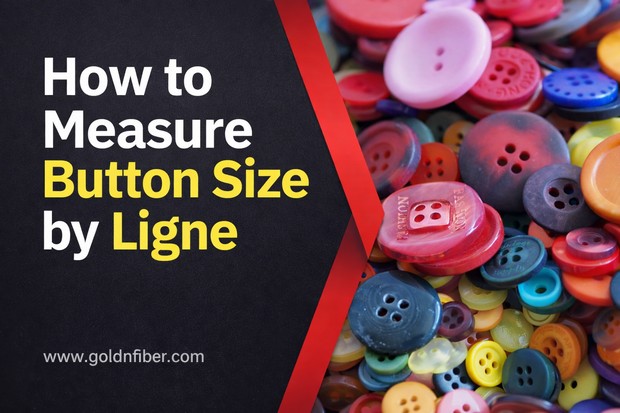
Usually, sewing button size is calculated by three units i.e. in mm (millimeter), inch and ligne as per buyer instructions, and the final size is usually confirmed against a sample card or tech pack.
To fix button size in mm or inch, first we need to measure the dia of button with measurement tape from one outer edge to the opposite outer edge, or a caliper for better accuracy. Now let’s find how to measure button size by ligne. If the Button length (die) is 14 mm then Button ligne will be what? After conversion, suppliers normally round to the nearest available commercial size.
How to Convert 14 mm Button Size to Ligne
To measure the button size, we will use Ligne, as we know 1 ligne = 0.635 mm and If button die is 14 mm:
Button die (in mm)/0.635 = button ligne
14 mm/0.635 = 22 L
(L = ligne)
Result = 22 L
Why Button Size Matters in Garment Production
Would you please think about a shirt without button. What are you thinking? Is it possible? The answer is no. Whether it is for men or women, it should have buttons at their wearer. Button is an essential element to make a fashionable wearer, and the button size should also suit the placket width and fabric weight.
Button Quantity Formula in Great Gross
Suppose,
If a jacket has 8 buttons and total order quantity of that jacket is 3780 pieces then figure out total button quantity in G.G?
Answer: 8 x 3780/1728 = 17.5 G.G
Formula: Number of buttons for each garments X volume of order / 1728 (1 G.G = 1728 pieces), and many buyers keep GG only for consumption planning while confirming the final order in pieces.
As we know,
- 12 Pieces = 1 Dozen,
- 12 Dozen = 1 Gross,
- 12 Gross = 1 G.G (1728 pieces)
Note: Minimum 3% additional quantity should add in consumption to erase hassle in bulk production like shortage, defect & damage etc. For printed, logo, painted, or metal-finish buttons, a slightly higher allowance can be safer if rejection risk is high.
Suppose:
A kids jacket contains 8 buttons, and total order quantity is about 5000 pcs. Let us find out total button quantity for the order.
Answer:
8 × 5000 ÷ 1728 = 23.15 GG (GG means Great Gross)
(Formula: number of buttons per product × order quantity ÷ 1728)
(1 GG = 1728 pcs) If the buyer asks for spare quantities separately, keep that allowance out of the main consumption figure.
How Much Does a Button Industry Cost to Start?
For a new entrepreneur:
- For setting up a medium button industry, someone needs to invest around USD 1.4 million to USD 1.75 million in current dollars, according to the U.S. Bureau of Labor Statistics CPI Inflation Calculator as initial capital.
- Such sectors can produce around 12,000-15,000 G.G (Great Gross- 1 G.G= 1728 pieces) buttons monthly in a multi-shift factory example, which equals about 20,736,000 to 25,920,000 pieces, but actual capacity varies by machine count, mold count, and downtime. Exporting price of these buttons is almost project-specific and should be quoted by order, because material, finish, packing, and destination market all change the value.
- Resin is the basic raw materials to produce plastic button, and today it is also sourced through domestic petrochemical suppliers and regional import markets what can be collected from Italy, Taiwan, or Singapore.
Modern button manufacturer is using Italian machinery with excellent environmental friendly raw materials such as free from harmful RSL substances like lead, cadmium, nickel, chromium and other dangerous items to assure the optimum quality of goods and to meet buyer compliance checks. Their diverse product line consists of Side Logo buttons, Color Logo, Triangular shape, 3Hole, Flower, Down Hole, Shank, Fish-eye buttons among much more. Some company has state of the art polyester button facility & integrated sewing thread dyeing factories set up. Your valuable comments and necessary advice will encourage me 🙂
Conclusion:
Correct button measurement in ligne keeps sampling, costing, and bulk ordering accurate, especially when you confirm size with mm, sample cards, and a small spare allowance.
Frequently Asked Questions (FAQs)
Q1. How do I convert button size from mm to ligne?
Ans: Divide the button diameter in mm by 0.635. Round the result to the nearest available size in your supplier’s chart.
Q2. What is 14 mm button size in ligne?
Ans: 14 mm is about 22L because 14 divided by 0.635 is 22.05. Most buyers round it to 22L in the size sheet.
Q3. How many pieces are in 1 gross and 1 great gross?
Ans: 1 gross is 144 pieces and 1 great gross is 1,728 pieces. Button consumption is often converted back to pieces before final ordering.
Q4. What is the formula for button quantity in garments?
Ans: Multiply the number of buttons per garment by the order quantity, then divide by 1,728 if you want great gross. If you want pieces, multiply buttons per garment by the order quantity directly.
Q5. How much extra button quantity should be added for bulk production?
Ans: A 3% allowance is a common starting point for standard buttons. For printed, dyed, or logo buttons, a slightly higher buffer may be safer.